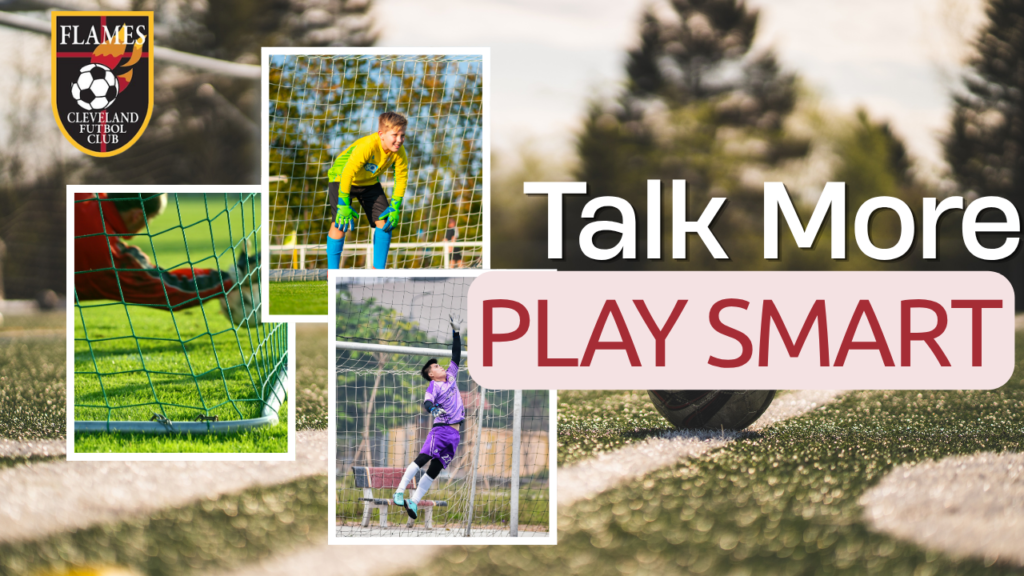
Why Communication Is One Of A Goalkeeper’s Most Important Tools
Goalkeepers are often judged by the saves they make.
The diving save.
The breakaway stop.
The catch through traffic.
The reaction on the goal line.
Those moments matter. But the best goalkeepers do not only make saves. They prevent problems before they ever become shots.
That is where communication becomes one of the most important parts of goalkeeper training.
At Cleveland Futbol Club, we want goalkeepers to understand that their job is bigger than standing in goal and reacting. A goalkeeper is a leader, organizer, problem-solver, and first attacker. The keeper has a view of the field that most players do not have. They can see the defensive shape, the attacking movement, the open players, the weak-side runner, the counterattack building, and the space behind the back line.
A smart goalkeeper uses that vision.
The philosophy is simple:
Work smarter, not harder.
A keeper who communicates well can help organize the team, reduce dangerous chances, start attacks earlier, and face fewer shots. That does not mean the goalkeeper avoids hard work. It means they learn how to solve problems before those problems turn into emergency saves.
The best save is often the one the goalkeeper never has to make.
The Goalkeeper As A Field General
A goalkeeper sees the game differently.
While field players are often focused on the ball, pressure, spacing, and their immediate opponent, the goalkeeper can see the larger picture. From behind the team, the keeper can help direct the defensive shape and guide players into better positions.
In many ways, a goalkeeper is like a chess player.
Every instruction matters. Every movement affects the next moment. A keeper who organizes defenders early can close passing lanes, stop runners, protect dangerous spaces, and help the team win the ball before the attack becomes dangerous.
That is why communication is not just noise.
It is leadership.
When a goalkeeper communicates clearly, the team becomes more organized. Defenders know where to move. Midfielders know when to drop. Players know who is marking. The back line knows when to step, when to hold, when to shift, and when the keeper is coming for the ball.
Good communication makes the goalkeeper’s job easier.
It also makes the entire team harder to break down.
Goalkeeper Communication Must Be Clear, Calm, And Confident
A goalkeeper’s voice carries emotion.
If a keeper sounds unsure, the team may become unsure.
If a keeper sounds panicked, the back line may panic.
If a keeper screams constantly, teammates may stop listening.
If a keeper stays quiet, defenders may miss important information.
The goal is not to yell the most.
The goal is to communicate the right message at the right time in the right way.
A goalkeeper’s voice should be:
- Firm
- Clear
- Specific
- Confident
- Loud enough to be heard
- Calm under pressure
A goalkeeper does not need to sound angry. A goalkeeper needs to sound in control.
There is a major difference between a commanding voice and a panicked voice. A commanding voice gives direction. A panicked voice creates chaos.
Young goalkeepers often think communication means shouting more. In reality, good communication means choosing words that help the team act quickly.
Keep Commands Short
During a game, defenders do not have time to process long sentences.
The ball is moving. Opponents are moving. Space is changing. A player under pressure may only hear one or two words.
That is why goalkeeper commands should be short and specific.
A long instruction like, “Somebody needs to go mark the player on the left side because he is open,” will usually be too late by the time it is understood.
A better command is:
“Jake, left!”
Or:
“Mia, 10!”
Or:
“Step up!”
Short commands help players react faster.
For youth goalkeepers, this is one of the biggest communication habits to build: say less, but make it matter more.
Verbal And Non-Verbal Communication
Goalkeeper communication can happen in two ways:
Verbal Communication
This is the keeper’s voice.
It includes commands, warnings, organization, and direction. Verbal communication must be loud enough to reach teammates and clear enough to be understood quickly.
Non-Verbal Communication
This is body language and hand signals.
Goalkeepers can point to open players, show where a back pass should go, use fingers to show how many players are needed in a wall, wave the team up the field, or direct defenders into position before a set piece.
Non-verbal communication is especially useful when the field is loud or when a quick visual cue is easier than a verbal instruction.
The best goalkeepers use both.
They speak with confidence and use their body language to support the message.
Common Goalkeeper Commands Every Keeper Should Know
Every team may use slightly different language, but the key is consistency. Whatever commands a goalkeeper uses, the team needs to understand them.
Below are common commands that young goalkeepers should learn and practice.
“Keeper”
This may be the most important word in the goalkeeper’s vocabulary.
The keeper call tells everyone that the goalkeeper is coming for the ball.
It must be loud, early, and confident.
Do not wait until the last second. The keeper should call before leaving the line or committing to the ball.
The command should be:
“Keeper!”
Not soft.
Not unsure.
Not halfway.
The call tells defenders to get out of the way, protect the goal if needed, and trust the goalkeeper’s decision. It also sends a message to attackers that the goalkeeper is committed.
When a goalkeeper calls “Keeper,” they must mean it.
Training Point
In practice, goalkeepers should rehearse calling “Keeper” during crosses, through balls, bouncing balls, and balls served into the box. The voice and action must work together.
“Away”
This tells defenders to clear the ball out of danger.
It is useful when the goalkeeper cannot claim the ball or when the safest decision is for a defender to remove pressure.
The command should be simple:
“Away!”
This is especially important on crosses, loose balls, or bouncing balls in the box.
Training Point
Keepers should learn the difference between “Keeper” and “Away.” If the keeper can claim it, call “Keeper.” If the defender needs to clear it, call “Away.”
Mixed messages create dangerous moments.
“Drop”
“Drop” tells a defender or line to move backward.
This can be used when a defender is too high, when there is space behind the back line, or when an opponent is preparing to play a ball over the top.
Examples:
“Drop!”
“Drop two!”
“Drop left!”
“Back line, drop!”
The more specific the command, the better.
Instead of just yelling “Drop!” repeatedly, the keeper should give useful information.
Who needs to drop?
How far?
Which side?
Training Point
Goalkeepers should practice using names with commands when possible. “Eli, drop two!” is clearer than “Drop!” with no direction.
“Step”
“Step” tells defenders to move forward.
This can help the team compact space, push attackers away from goal, or move the line up after the ball has been cleared.
Examples:
“Step!”
“Step up!”
“Step to 18!”
“Back line, step!”
This command must be used carefully. Calling the team up at the wrong time can create space behind the defense.
A goalkeeper should call “Step” when the ball is secure, cleared, or when the team has a clear chance to move the line higher.
Training Point
Teach young keepers to read the moment. If there is immediate shooting danger or a loose ball near the box, the team may need to hold instead of stepping.
“Hold”
“Hold” tells defenders not to drop or step, but to stay connected in their current line.
This is useful when a keeper wants the back line to stay organized and not get pulled apart.
Examples:
“Hold!”
“Line, hold!”
This command helps prevent defenders from chasing too deep or stepping at the wrong time.
“Mark”
“Mark” by itself is often not enough.
If a goalkeeper yells, “Mark! Mark! Mark!” defenders may not know who needs to mark, where the danger is, or which player is open.
A better command includes a name, number, or location.
Examples:
“Jay, 10!”
“Sam, back post!”
“Alex, runner left!”
“Mia, front post!”
Specific communication removes confusion.
A goalkeeper should not ask, “Who has number 8?” when the danger is already happening. The keeper should assign responsibility.
Training Point
During set pieces or defensive moments, goalkeepers should scan for unmarked players and give direct instructions. “Landon, 7!” is faster and stronger than asking the team to figure it out.
“Back”
“Back” should be used carefully because it can mean different things to different players.
If a goalkeeper is available for a pass, a clearer command is:
“Keeper back!”
The keeper should also point to where the ball should be played. This helps the defender understand that the goalkeeper is an option and where the pass should go.
A goalkeeper should avoid using “Back” for too many different meanings. If “Back” means pass to the keeper in one moment and drop defensively in another, confusion can happen.
Training Point
Use consistent language. If “Keeper back” means pass to the keeper, use “Drop” when defenders need to move backward.
“Outside”
“Outside” tells the player with the ball to move or pass toward the outside of the field instead of turning inside into pressure.
This command is helpful when the goalkeeper can see pressure coming from the middle.
Examples:
“Outside!”
“Take it outside!”
This helps defenders avoid dangerous turnovers in central areas.
Training Point
Goalkeepers should use this when they can clearly see that the inside option is closed or dangerous.
“Turn”
“Turn” tells a teammate they have time and space to receive the ball and face forward.
This is useful when the goalkeeper can see that the player is not under immediate pressure.
Example:
“Turn!”
This can help start attacks and give teammates confidence to play forward.
“Man On”
“Man on” tells a teammate that pressure is coming.
This command should be early and urgent, but not panicked.
Example:
“Man on!”
This helps the player protect the ball, play quickly, or use a safer option.
“Time”
“Time” tells a player they are not under immediate pressure.
Example:
“Time!”
This can help a defender settle, take a touch, and make a better decision.
“Wall”
On free kicks near goal, the goalkeeper must take charge.
The keeper should call for the wall and the number of players needed.
Examples:
“Wall!”
“Three wall!”
“Two wall!”
Once the wall is set, the goalkeeper should position it with short, clear commands.
Examples:
“Left one!”
“Right two!”
“Hold!”
The keeper should also organize players not in the wall. Marking runners, protecting zones, and preparing for rebounds are all part of the job.
Training Point
Free kick organization should be practiced. It should not be something the goalkeeper figures out for the first time in a game.
Communication Before, During, And After The Play
Goalkeeper communication happens in three phases.
Before The Play
This is organization.
The keeper helps teammates get into the right spots before the danger arrives.
Examples:
“Sam, 9!”
“Back post!”
“Line, step!”
“Watch runner!”
This is where smart goalkeepers prevent problems.
During The Play
This is decision-making.
The keeper gives quick commands as the ball moves.
Examples:
“Keeper!”
“Away!”
“Man on!”
“Outside!”
These commands must be fast and clear.
After The Play
This is resetting.
Once the ball is cleared, saved, or out of play, the keeper helps the team reorganize.
Examples:
“Step out!”
“Find marks!”
“Reset!”
“Push up!”
After the moment ends, the keeper helps the team prepare for the next one.
The Keeper As The First Attacker
Goalkeepers are not only part of the defense.
They are also the first attacker.
Once the keeper wins the ball, catches a cross, makes a save, or receives a back pass, they have a chance to help the team attack.
Good communication helps here too.
A keeper can point players higher, tell defenders to spread out, direct a midfielder into space, or quickly distribute to start a counterattack.
Examples:
“Wide!”
“Push!”
“Check!”
“Turn!”
“Go!”
The goalkeeper should constantly read the field.
Can we counter quickly?
Do we need to slow the game down?
Is there an open player wide?
Is the other team unbalanced?
Should we build from the back?
A calm goalkeeper helps the team make better choices in possession.
Do Not Over-Communicate
Communication is important, but more talking is not always better.
If a goalkeeper talks nonstop, teammates may begin to tune it out. The keeper’s voice can become background noise.
The goal is effective communication.
Speak when the information helps.
Be clear.
Be specific.
Be consistent.
Then allow teammates to play.
A goalkeeper should not coach every touch or criticize every mistake. Communication should build trust, not frustration.
The best keepers know when to speak, what to say, and when to let the game breathe.
Building Confidence In A Young Goalkeeper’s Voice
Many young goalkeepers struggle to communicate because they are afraid of being wrong, sounding bossy, or drawing attention to themselves.
That is normal.
Confidence grows with practice.
Goalkeepers should train their voice just like they train footwork, handling, diving, and distribution.
Ways To Practice Communication
1. Use Commands During Training
Even in simple goalkeeper drills, require the keeper to call:
“Keeper!”
“Away!”
“Set!”
“Left!”
“Right!”
The more often they say it in practice, the more natural it becomes in games.
2. Practice With Defenders
Goalkeeper communication improves when defenders are involved. Small group training with a keeper and back line can help players learn the same language.
3. Use Names
Calling a player’s name creates ownership and clarity.
“Ben, drop!” is stronger than “Somebody drop!”
4. Review Game Moments
After games, ask the keeper:
What did you see?
What could you have said earlier?
Where could communication have prevented danger?
When did your voice help the team?
This turns communication into a learning habit.
Simple Goalkeeper Communication Training Activity
Here is a simple activity teams can use during goalkeeper training.
The Organization Game
Set up:
- One goalkeeper
- Three or four defenders
- Three or four attackers
- A small field or half-field space
The attacking team starts with the ball and tries to create a chance. The goalkeeper must organize the defenders using short commands.
Focus on:
- Marking
- Dropping
- Stepping
- Tracking runners
- Calling “Keeper” or “Away”
- Resetting after the ball is cleared
The coach can pause the game and ask:
What did the keeper see?
Was the command specific?
Did the defender understand it?
Could the keeper have spoken earlier?
This helps goalkeepers connect what they see with what they say.
Common Mistakes Young Goalkeepers Make
Talking Too Late
If the keeper waits until the danger is already happening, the command may not help.
Goalkeepers need to scan early and speak early.
Being Too Quiet
A command that teammates cannot hear is not useful.
The keeper does not need to scream, but the voice must carry.
Using Vague Commands
“Mark up!” is sometimes useful, but it may not solve the immediate problem.
“Liam, back post!” is better.
Sounding Panicked
Panic spreads quickly. A goalkeeper’s voice should bring calm and direction.
Blaming Instead Of Leading
Communication should organize, not embarrass teammates. A keeper can be demanding without being negative.
Final Thought: The Smart Keeper Makes The Game Easier
A goalkeeper’s job is not easy.
They must save shots, read danger, organize defenders, manage space, distribute the ball, and lead from the back. But the smartest keepers learn that communication can make everything easier.
A clear voice can prevent a free runner.
A quick command can stop a bad pass.
A confident call can claim a cross.
A simple instruction can move the whole back line.
A calm reset can help the team recover.
At Cleveland Futbol Club, we want goalkeepers to develop the full position. That means shot-stopping, handling, footwork, distribution, bravery, and leadership.
But it also means learning how to think the game and organize the players in front of them.
Work smarter, not harder.
Use your eyes.
Use your voice.
Lead with confidence.
Make the game easier for yourself and your team.
No Comments yet!