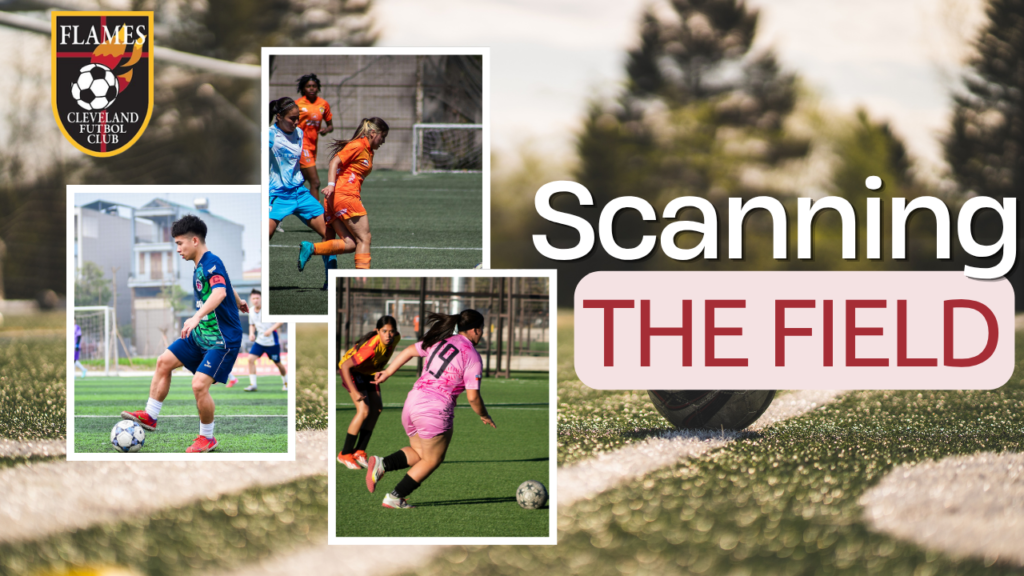
How Checking Your Shoulder Helps Players Play Faster, Smarter, And With More Confidence
Some of the best soccer skills are easy to see.
A clean first touch.
A sharp turn.
A great pass.
A strong tackle.
A composed finish.
But one of the most important skills in the game often happens before the ball even arrives.
It is called scanning.
Players may also hear coaches call it checking your shoulder, taking a picture, or getting your head up. Whatever language is used, the idea is the same: a player looks around before, during, and after receiving the ball so they can understand what is happening around them.
At Cleveland Futbol Club, scanning is a major part of Soccer IQ because it helps players make better decisions. A player who scans knows more. A player who knows more can play faster. A player who plays faster can handle pressure with more confidence.
The ball may be at your feet for only a few seconds.
Your brain has to be ready before it gets there.
What Is Scanning In Soccer?
Scanning is the habit of looking away from the ball for a quick moment to gather information.
A player scans to see:
- Where teammates are
- Where opponents are
- Where open space is
- Where pressure is coming from
- Whether they can turn
- Whether they should pass quickly
- Whether they can dribble forward
- Whether there is danger nearby
Scanning is not just looking around randomly. It is purposeful.
The player is collecting information that helps them decide what to do next.
A simple example:
A midfielder is about to receive a pass. Before the ball arrives, they check over their shoulder. They see a defender closing from behind and a teammate open to the right. Because they scanned early, they already know the next action. Instead of turning into pressure, they play quickly to the open teammate.
That is Soccer IQ in action.
Why Scanning Matters
Soccer moves fast.
By the time the ball arrives, it may be too late to start thinking. Pressure closes quickly. Passing lanes disappear. Space opens and closes in seconds.
Scanning gives players a head start.
It helps them answer important questions before they receive the ball:
Do I have time?
Can I turn?
Is someone behind me?
Where is my next pass?
Can I play forward?
Should I protect the ball?
Should I play one-touch?
Where is the safest option?
Where is the dangerous option?
A player who does not scan often receives the ball and then starts looking. That player is already behind the play.
A player who scans receives the ball with a plan.
That small difference can change everything.
Scanning Helps The Game Slow Down
When players are young, the game can feel frantic.
They get the ball, panic, look down, take extra touches, and feel pressure before they have time to think. This is normal. The game is busy. There are teammates, opponents, coaches, parents, space, noise, and the little round troublemaker bouncing around their feet.
Scanning helps calm the chaos.
When players scan, they begin building a mental picture of the field. They know where pressure is. They know where support is. They know what the next option might be.
That makes the game feel slower.
The ball is still moving fast, but the player is no longer surprised by everything.
Good players are not always faster because they run faster. Many times, they are faster because they see earlier.
The Best Players Take Pictures
Coaches often tell players to “take a picture” before the ball arrives.
That is a great way to explain scanning.
A player takes a quick picture of the field, then uses that picture to make a decision.
Of course, the picture changes quickly. Players move. Space changes. Pressure shifts. That is why scanning must happen often, not just once.
Players should scan:
Before the ball comes
As the ball travels
After they pass
When they move into space
When possession changes
When defending
Before making a run
Before receiving under pressure
The more pictures a player takes, the clearer the game becomes.
Scanning And First Touch Work Together
A player’s first touch should have a purpose.
But it is hard to take a purposeful first touch if the player does not know what is around them.
Scanning helps the first touch become smarter.
If a player scans and sees space behind them, their first touch may open their body and turn forward.
If they scan and see pressure coming, their first touch may protect the ball or set up a quick pass.
If they scan and see a teammate open wide, their first touch may prepare the pass.
If they scan and see no safe forward option, they may choose to keep possession and recycle the ball.
Without scanning, the first touch is often just a reaction.
With scanning, the first touch becomes a decision.
Scanning Is Not Just For Midfielders
Central midfielders need to scan constantly because the game happens all around them. They often receive the ball with pressure from several directions.
But scanning matters for every position.
Goalkeepers
Goalkeepers scan to see pressure, passing options, defensive shape, runners behind the back line, and chances to distribute quickly.
Defenders
Defenders scan to track runners, stay connected to the back line, recognize pressure, and find safe passing options when building out.
Midfielders
Midfielders scan to receive under pressure, turn, connect passes, switch the field, and protect possession.
Wingers
Wingers scan to know if they can turn, attack the defender, combine inside, cross early, or make a run behind.
Forwards
Forwards scan to time runs, stay onside, find gaps between defenders, check the goalkeeper’s position, and prepare to finish.
Every player can become smarter by scanning more.
When Should Players Scan?
Scanning works best when players learn the right moments to check.
1. Before Receiving The Ball
This is the biggest one.
Before the ball arrives, players should check their shoulder to see pressure and options.
2. While The Ball Is Traveling
When a pass is coming, there is a brief moment where the player can glance around, then get eyes back on the ball for the first touch.
This takes practice, but it is a powerful habit.
3. After Passing The Ball
The game does not stop after a pass.
Players should scan after releasing the ball so they can move into a better supporting position.
4. During Defensive Moments
Defenders and midfielders must scan to track runners and protect space. Ball-watching is one of the easiest ways to lose a player.
5. During Transitions
When possession changes, everything changes.
If your team wins the ball, scan for counterattack options.
If your team loses the ball, scan for danger and recovery positions.
Transitions are fast. Scanning helps players react smarter.
How To Train Scanning At Home
Scanning can be trained. Players do not need a full team session to improve this habit.
The goal is to connect the eyes, brain, and feet.
Players should learn to look, process, decide, and act.
Below are simple scanning drills players can use at home.
Drill 1: Cone Awareness Circle
Set up four to six cones, shoes, or markers in a circle around the player. Each marker can have a color, number, or name.
The player starts in the middle with a ball.
Dribble in a small space. Every few seconds, check over the shoulder, find a marker, and call it out loud.
Then continue dribbling.
Progressions
Dribble faster.
Use only the weak foot.
Add more markers.
Call out two markers at once.
Have a parent or teammate call a color or number randomly.
Why It Helps
This drill teaches players to keep the ball under control while gathering information around them.
It builds the habit of looking away from the ball without losing control.
Drill 2: Wall Pass With Shoulder Check
Find a safe wall or rebounder.
Place one cone or marker to the left or right side of the player.
Pass the ball into the wall. As the ball travels back, quickly check over the shoulder to identify the marker. Then receive the ball and take the first touch toward that marker.
Progressions
Put a marker on both sides.
Have someone call left or right after the pass.
Use different colored markers and call out the color.
Receive with one foot and pass with the other.
Add a one-touch pass if pressure is imagined.
Why It Helps
This drill copies a real game moment.
The player passes, scans while the ball is moving, receives, and takes the next touch based on what they saw.
That is exactly how scanning should connect to decision-making.
Drill 3: Turn Or Play Back
Set up a wall and two markers behind the player: one close and one farther away.
The close marker represents pressure. The farther marker represents space.
Pass the ball into the wall. Before receiving, scan over the shoulder.
If the “pressure” marker is the target, play one-touch back to the wall.
If the “space” marker is the target, open up and turn.
A parent, coach, or teammate can call “pressure” or “space” as the ball travels.
Why It Helps
This teaches players that scanning should change the decision.
Sometimes the right answer is to turn.
Sometimes the right answer is to play simple.
Sometimes the smartest play is the fastest safe pass.
Drill 4: Watch And Call
This is a simple drill for younger players.
A player dribbles in a small area. A parent or teammate stands behind them and holds up fingers, a color, or an object.
The player checks their shoulder, calls out what they see, then keeps dribbling.
Progressions
Use both shoulders.
Increase dribbling speed.
Add turns after each scan.
Use a smaller space.
Call out a move after the scan.
Why It Helps
This builds comfort looking away from the ball and quickly processing information.
Drill 5: Scan Before The First Touch
Set up with a partner.
The partner passes the ball to the player. Before the ball arrives, the player must check one shoulder, call out what they see, then take a first touch into space.
The partner can stand behind the player and point left or right. The player must scan, identify the direction, and take the first touch that way.
Why It Helps
This connects scanning directly to first touch.
Players learn that the first touch should be based on information, not panic.
How Coaches Can Teach Scanning
Coaches can help players build scanning habits by making it part of everyday training language.
Simple reminders help:
Check your shoulder.
Take a picture.
What did you see?
Can you turn?
Where is the pressure?
Where is the space?
What is your next option?
But players also need activities where scanning matters.
If every drill is predictable, players may not need to look around. Coaches can add decisions, defenders, colors, numbers, or directional cues so players must gather information before acting.
Coaching Ideas
Ask players what they saw before receiving.
Reward players who scan before the ball arrives.
Freeze play and show the picture.
Use small-sided games with target zones.
Add color or number cues in passing activities.
Encourage players to call “turn,” “man on,” or “time” for teammates.
The goal is not to overload players.
The goal is to build the habit slowly until scanning becomes natural.
How Players Can Study Scanning While Watching Soccer
Players can improve Soccer IQ by watching games differently.
Instead of only watching the ball, pick one player and follow them for several minutes.
Watch their head.
Do they check their shoulder before receiving?
Do they scan after passing?
Do they look across the defensive line before making a run?
Do they check the goalkeeper before shooting?
Do they adjust their body shape based on what they saw?
Midfielders are great players to study because they scan constantly. But every position has scanning habits worth noticing.
A forward checks the back line.
A defender checks runners.
A winger checks the fullback and the space behind.
A goalkeeper scans passing options before distribution.
Watching soccer with purpose helps players see the invisible work that happens before the highlight.
Scanning Helps Players Communicate
When players scan, they do not only help themselves.
They can help teammates too.
If a player sees pressure coming, they can say:
“Man on!”
If a teammate has space, they can say:
“Turn!”
If the team needs to move the ball, they can say:
“Switch!”
If a defender loses a runner, a scanning teammate can warn them.
Communication becomes better when players actually see the field.
Scanning gives players information. Communication shares it.
That helps the whole team.
Common Scanning Mistakes
Only Looking After The Ball Arrives
This is too late. Players need information before the ball gets to them.
Looking But Not Processing
Some players turn their head but do not actually register anything. A real scan should answer a question: where is pressure, space, or support?
Staring Too Long
A scan should be quick. Players still need eyes back on the ball before the first touch.
Only Scanning On The Ball
Scanning matters off the ball too. Players should constantly update their picture as they move.
Forgetting To Scan When Tired
Fatigue causes players to ball-watch. Smart players keep checking even late in games.
A Simple Scanning Challenge For Players
Try this during your next training week.
Day 1: Wall Pass Scanning
Complete 50 wall passes. Check your shoulder before every first touch.
Day 2: Cone Awareness
Dribble for five rounds of one minute. Scan and call out a cone color or number every few seconds.
Day 3: Watch A Game
Pick one player and watch their head movement for 10 minutes. Count how often they scan before receiving.
Day 4: First Touch Direction
Have a partner call left or right before the ball arrives. Scan, receive, and take your first touch that direction.
Day 5: Game Application
At practice or in a game, focus on scanning before every time you receive the ball.
The goal is not perfection.
The goal is awareness.
Final Thought: Better Vision Builds Better Decisions
Scanning is one of the hidden skills that makes the game easier.
It helps players play quicker, stay calmer, avoid pressure, find teammates, track runners, and make better decisions.
It is not magic. It is a habit.
Players who scan are not guessing. They are gathering information. They are building a picture. They are preparing before the ball arrives.
At Cleveland Futbol Club, we want players who can think the game, not just react to it.
That starts with learning to see the game.
Check your shoulder.
Take the picture.
Use the information.
Play with purpose.
That is Soccer IQ.
No Comments yet!