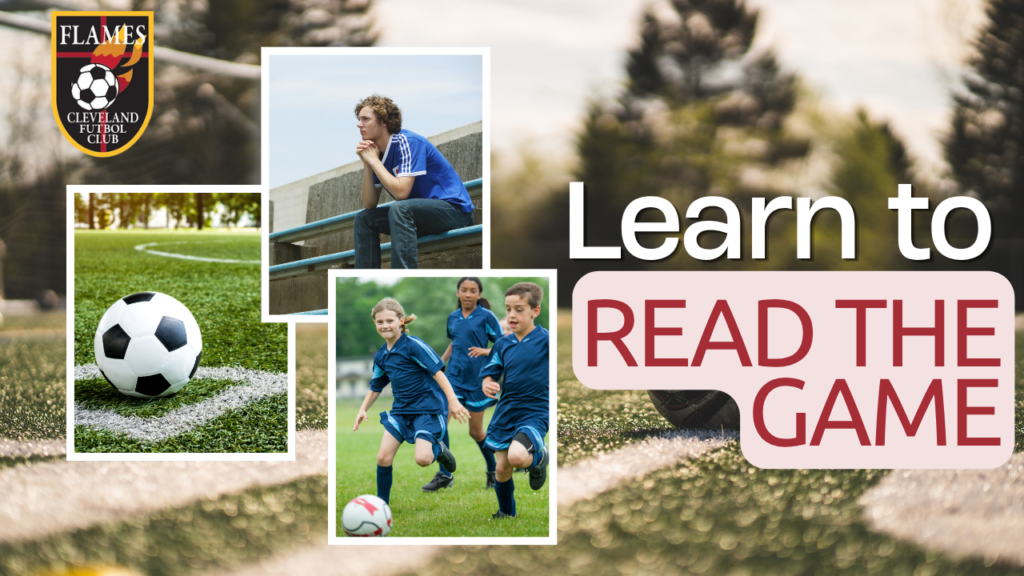
How Players Can Learn To Read The Game

Building Smarter, More Confident Soccer Players

Soccer is more than speed, strength, and skill.

Those things matter. A player needs technical ability. They need to be able to run, compete, pass, dribble, defend, and finish. But as players grow, the game becomes faster, more complex, and more demanding.

That is when Soccer IQ starts to separate players.

Soccer IQ is the ability to understand the game. It is how a player reads pressure, recognizes space, anticipates movement, makes decisions, communicates with teammates, and adjusts to different game situations.

A player with strong Soccer IQ does not just react to the game.

They begin to read it.

They start to notice where pressure is coming from. They understand when to pass, when to dribble, when to shoot, when to keep possession, and when to play simple. They know how to support teammates, how to move off the ball, and how to make the game easier for the players around them.

At Cleveland Futbol Club, we believe player development should include more than physical and technical growth. We want players who can think the game, solve problems, and play with purpose.

That is what Soccer IQ is all about.


What Is Soccer IQ?

Soccer IQ is a player’s ability to understand what is happening in the game and make smart decisions based on that information.

It includes:

  • Reading the field
  • Understanding space
  • Recognizing pressure
  • Making good decisions under pressure
  • Knowing your role and position
  • Anticipating what may happen next
  • Communicating with teammates
  • Adjusting to different game situations
  • Learning from mistakes and experience

Soccer IQ does not mean a player always makes the perfect decision. No player does that.

It means the player is learning to make decisions with awareness and purpose.

A young player may ask, “What do I do now?”

A smarter player starts asking, “What does the game need right now?”

That shift matters.


The Key Parts Of Soccer IQ

1. Tactical Awareness

Tactical awareness means understanding how the team is trying to play.

This includes formations, team shape, pressing, defending, building out, attacking patterns, transitions, and spacing. Younger players do not need to know every advanced tactical term, but they should begin learning simple ideas.

Where should we be when we have the ball?
Where should we be when we lose it?
How do we create space?
How do we protect the middle?
When do we press?
When do we recover?
How do we support the player on the ball?

Tactical awareness helps players understand the bigger picture.

They begin to see how their role connects to the team.


2. Game Vision

Game vision is the ability to see options.

Some players only see the ball. Smarter players see the ball, the pressure, the space, the defenders, the passing lanes, and the next action.

Game vision improves when players scan the field, check their shoulders, and learn to play with their head up.

A player with good vision may notice:

A teammate making a run behind the defense
A defender stepping too high
A pocket of space between lines
A chance to switch the field
A safe pass that keeps possession
A better option before pressure arrives

Vision gives players more choices.

More choices usually lead to better decisions.


3. Decision-Making

Decision-making is one of the biggest parts of Soccer IQ.

A player may have great foot skills, but if they dribble into three defenders every time, those skills are not helping the team. Another player may not be flashy, but they may consistently make the right pass, support the ball, and keep the team connected.

Good players ask:

Can I go forward?
Should I keep the ball?
Is there pressure?
Can I turn?
Is a teammate in a better position?
Should I pass, dribble, shoot, or reset?

Decision-making becomes harder under pressure. That is why players need training environments that force them to think quickly.

Small-sided games, possession games, one-touch activities, and game-like situations help players learn to make decisions when space and time are limited.

The goal is not to create robots.

The goal is to develop players who can solve problems.


4. Positional Understanding

Every position has different responsibilities.

A defender does not read the game the same way as a forward. A midfielder has different pictures to solve than a goalkeeper. A winger sees different options than a center back.

Players should learn their position, but they should also understand how other positions work. The more a player understands the whole game, the better teammate they become.

Position-Specific Soccer IQ

Goalkeepers need to read danger, organize the back line, communicate clearly, manage space behind the defense, and start attacks with smart distribution.

Defenders need to anticipate attacking movement, track runners, protect dangerous space, win duels, and make good choices when playing out.

Midfielders need to scan constantly, receive under pressure, connect teammates, switch the field, protect possession, and control the rhythm of the game.

Forwards need to time runs, find gaps, press intelligently, hold the ball when needed, combine with teammates, and finish chances.

Wingers need to recognize when to attack 1v1, when to cross, when to combine, when to make runs behind, and when to help defensively.

Understanding the role helps players move with purpose instead of wandering through the game like a lost sock in a tournament bag.


5. Anticipation

Anticipation is the ability to read what may happen before it happens.

This is a powerful part of Soccer IQ.

A defender who anticipates a pass can step in and win it.
A midfielder who anticipates pressure can play one-touch.
A forward who anticipates a through ball can start the run early.
A goalkeeper who anticipates danger can organize before the shot happens.

Anticipation comes from watching, scanning, experience, and learning patterns.

Players begin to notice things like:

A player’s body shape before a pass
A defender stepping out of line
A teammate preparing to cross
An opponent looking down before dribbling
A weak-side runner sneaking behind
A pressing trap forming

The earlier a player sees the clue, the sooner they can act.


How Players Can Improve Soccer IQ

Soccer IQ can be trained.

Some players may naturally read the game well, but every player can improve with better habits and intentional learning.


1. Watch Soccer With Purpose

Watching high-level soccer can help players understand the game, but only if they watch with intention.

Do not just watch the ball.

Pick one player and study them for five to ten minutes. Choose a player who plays your position and watch what they do when they do not have the ball.

Ask:

Where do they move?
When do they check their shoulder?
How do they support teammates?
When do they press?
When do they drop?
How do they create space?
What do they do after passing?
How do they react when possession changes?

Players can learn a lot by watching movement away from the ball. That is where Soccer IQ lives.


2. Learn Basic Tactical Ideas

Players do not need to memorize a coaching textbook to become smarter.

Start with simple tactical concepts.

Important Concepts To Learn

Pressing: How and when to pressure the ball.

Recovery: How to get back behind the ball when possession is lost.

Support: How to give the player on the ball a passing option.

Width: How to stretch the field and create space.

Depth: How to create forward and backward passing options.

Switching play: Moving the ball from one side of the field to the other.

Transition: The moment when the team wins or loses the ball.

Marking: Knowing who or what space you are responsible for defensively.

Playing forward: Looking to advance the ball when the option is available.

When players understand these ideas, coaching instructions start to make more sense.

They are not just being told where to go.

They begin to understand why.


3. Train Decision-Making Under Pressure

Players need activities that force quick thinking.

A drill with no pressure may help technique, but the game includes defenders, space, timing, and decision-making. Players need both technical repetition and game-like decisions.

Ways to train decision-making:

  • Small-sided games
  • 1v1, 2v1, and 3v2 situations
  • Possession games
  • One-touch and two-touch passing
  • Rondo-style activities
  • Transition games
  • Directional games with goals or targets
  • Training moments with limited space

These activities help players process information faster.

They learn when to pass, when to dribble, when to shoot, and when to keep the ball.


4. Build Better Scanning Habits

Scanning means checking your surroundings before the ball arrives.

This is one of the most important habits for Soccer IQ.

Players should learn to check their shoulder so they know:

Where pressure is
Where teammates are
Where space is
Whether they can turn
Whether they need to play quickly
What their first touch should do

A player who scans receives the ball with information.

A player who does not scan receives the ball and then starts searching.

That one-second delay can be the difference between keeping the ball and losing it.

Simple scanning habits:

Check before receiving.
Check as the ball travels.
Check after passing.
Check during transitions.
Check defensively to track runners.

Scanning turns panic into preparation.


5. Understand Your Position

Players should learn the responsibilities of their position, but they should also learn how their position connects to others.

A center back should understand how the goalkeeper supports them.
A midfielder should understand the forward’s movement.
A winger should understand the outside back’s overlap.
A forward should understand how their press affects the midfield behind them.

Soccer is connected.

When one player moves, it changes the picture for everyone else.

The more a player understands those connections, the better decisions they can make.


6. Learn From Mistakes

Mistakes are part of development.

A bad pass, missed run, poor touch, or wrong decision can become useful if the player learns from it.

Players should reflect after games and practices.

Ask:

What did I see?
What did I miss?
Was there a better option?
Did I scan early enough?
Was my body shape open?
Did I help my teammates?
Did I react quickly when possession changed?

Reflection helps players turn experience into growth.

A player who makes mistakes and learns is developing.

A player who makes mistakes and ignores them stays stuck.


7. Communicate More Clearly

Soccer IQ is not only about what a player sees.

It is also about helping teammates.

Good communication makes the whole team smarter.

Useful commands include:

Man on!
Turn!
Time!
Switch!
Drop!
Step!
Press!
Hold!
Away!

Communication should be short, clear, and helpful.

Players should not talk just to make noise. They should share information that helps teammates make better decisions.

A player who communicates well can organize, encourage, warn, and connect the team.


8. Train The Mental Side

Soccer is emotional.

Players make decisions while tired, nervous, excited, frustrated, or under pressure. Soccer IQ improves when players learn how to stay calm and focused in those moments.

Mental habits that help:

Stay focused after mistakes.
Take a breath before restarting play.
Keep scanning even when tired.
Listen to coaching points.
Stay connected to teammates.
Think about the next play, not the last mistake.
Visualize game situations before training or matches.

Smart players are not perfect.

They recover quickly, stay engaged, and keep solving the game.


A Simple Soccer IQ Challenge For Players

Here is a simple weekly challenge players can use to build game understanding.

Day 1: Watch Your Position

Watch 10 minutes of a game and focus only on one player in your position. Write down three things they do without the ball.

Day 2: Scan Before Receiving

During training or at home, focus on checking your shoulder before every pass you receive.

Day 3: Ask One Question

Ask your coach one question about your position or a decision from practice.

Day 4: Play With A Touch Limit

In a small-sided game or wall passing session, use one or two touches to force quicker decisions.

Day 5: Reflect

Write down one good decision you made and one decision you want to improve.

Small habits like this help players become students of the game.


How Parents Can Support Soccer IQ

Parents can help without turning every car ride into a postgame press conference under stadium lights.

Simple questions work best:

What did you notice today?
What was one smart decision you made?
Where did you find space?
What was one moment you would handle differently?
What did your coach ask your team to focus on?

The goal is reflection, not pressure.

Players need room to think, learn, and grow.


Final Thought: Smart Players Make The Game Easier

Soccer IQ helps players connect all parts of the game.

Technical skill gives players tools.
Soccer IQ helps them choose the right tool.

Speed helps players move.
Soccer IQ helps them move at the right time.

Strength helps players compete.
Soccer IQ helps them use their body wisely.

Confidence helps players try things.
Soccer IQ helps them understand when and why.

At Cleveland Futbol Club, we want players who are confident, creative, competitive, and intelligent. We want players who can play with the ball, move without it, communicate with teammates, and understand the game at a deeper level.

The game rewards players who think.

Read the field.
Check your shoulder.
Find the space.
Make the decision.
Learn from the moment.

That is how Soccer IQ grows.
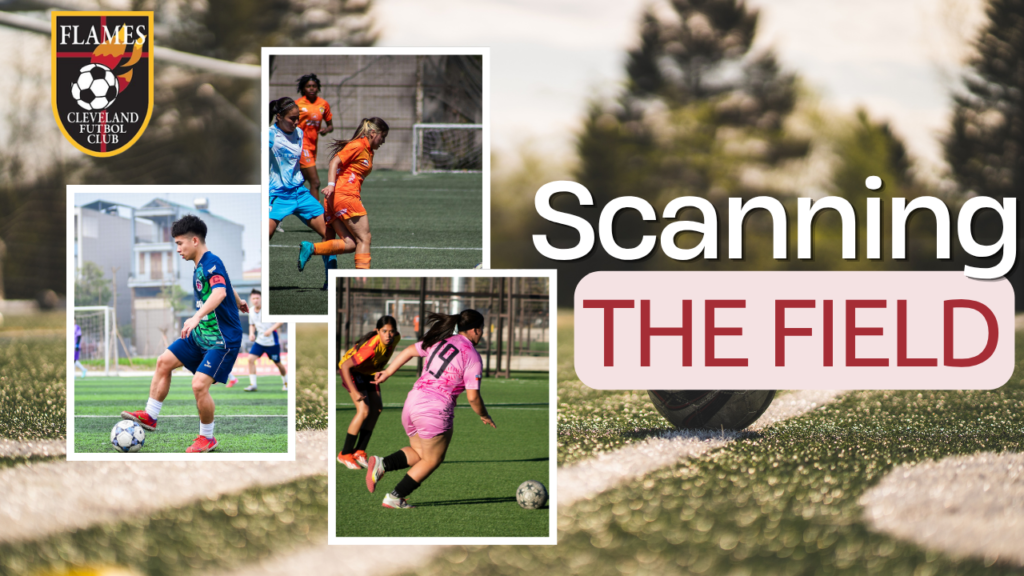
The Art Of Scanning

How Checking Your Shoulder Helps Players Play Faster, Smarter, And With More Confidence

Some of the best soccer skills are easy to see.

A clean first touch.
A sharp turn.
A great pass.
A strong tackle.
A composed finish.

But one of the most important skills in the game often happens before the ball even arrives.

It is called scanning.

Players may also hear coaches call it checking your shoulder, taking a picture, or getting your head up. Whatever language is used, the idea is the same: a player looks around before, during, and after receiving the ball so they can understand what is happening around them.

At Cleveland Futbol Club, scanning is a major part of Soccer IQ because it helps players make better decisions. A player who scans knows more. A player who knows more can play faster. A player who plays faster can handle pressure with more confidence.

The ball may be at your feet for only a few seconds.

Your brain has to be ready before it gets there.


What Is Scanning In Soccer?

Scanning is the habit of looking away from the ball for a quick moment to gather information.

A player scans to see:

  • Where teammates are
  • Where opponents are
  • Where open space is
  • Where pressure is coming from
  • Whether they can turn
  • Whether they should pass quickly
  • Whether they can dribble forward
  • Whether there is danger nearby

Scanning is not just looking around randomly. It is purposeful.

The player is collecting information that helps them decide what to do next.

A simple example:

A midfielder is about to receive a pass. Before the ball arrives, they check over their shoulder. They see a defender closing from behind and a teammate open to the right. Because they scanned early, they already know the next action. Instead of turning into pressure, they play quickly to the open teammate.

That is Soccer IQ in action.


Why Scanning Matters

Soccer moves fast.

By the time the ball arrives, it may be too late to start thinking. Pressure closes quickly. Passing lanes disappear. Space opens and closes in seconds.

Scanning gives players a head start.

It helps them answer important questions before they receive the ball:

Do I have time?
Can I turn?
Is someone behind me?
Where is my next pass?
Can I play forward?
Should I protect the ball?
Should I play one-touch?
Where is the safest option?
Where is the dangerous option?

A player who does not scan often receives the ball and then starts looking. That player is already behind the play.

A player who scans receives the ball with a plan.

That small difference can change everything.


Scanning Helps The Game Slow Down

When players are young, the game can feel frantic.

They get the ball, panic, look down, take extra touches, and feel pressure before they have time to think. This is normal. The game is busy. There are teammates, opponents, coaches, parents, space, noise, and the little round troublemaker bouncing around their feet.

Scanning helps calm the chaos.

When players scan, they begin building a mental picture of the field. They know where pressure is. They know where support is. They know what the next option might be.

That makes the game feel slower.

The ball is still moving fast, but the player is no longer surprised by everything.

Good players are not always faster because they run faster. Many times, they are faster because they see earlier.


The Best Players Take Pictures

Coaches often tell players to “take a picture” before the ball arrives.

That is a great way to explain scanning.

A player takes a quick picture of the field, then uses that picture to make a decision.

Of course, the picture changes quickly. Players move. Space changes. Pressure shifts. That is why scanning must happen often, not just once.

Players should scan:

Before the ball comes
As the ball travels
After they pass
When they move into space
When possession changes
When defending
Before making a run
Before receiving under pressure

The more pictures a player takes, the clearer the game becomes.


Scanning And First Touch Work Together

A player’s first touch should have a purpose.

But it is hard to take a purposeful first touch if the player does not know what is around them.

Scanning helps the first touch become smarter.

If a player scans and sees space behind them, their first touch may open their body and turn forward.

If they scan and see pressure coming, their first touch may protect the ball or set up a quick pass.

If they scan and see a teammate open wide, their first touch may prepare the pass.

If they scan and see no safe forward option, they may choose to keep possession and recycle the ball.

Without scanning, the first touch is often just a reaction.

With scanning, the first touch becomes a decision.


Scanning Is Not Just For Midfielders

Central midfielders need to scan constantly because the game happens all around them. They often receive the ball with pressure from several directions.

But scanning matters for every position.

Goalkeepers

Goalkeepers scan to see pressure, passing options, defensive shape, runners behind the back line, and chances to distribute quickly.

Defenders

Defenders scan to track runners, stay connected to the back line, recognize pressure, and find safe passing options when building out.

Midfielders

Midfielders scan to receive under pressure, turn, connect passes, switch the field, and protect possession.

Wingers

Wingers scan to know if they can turn, attack the defender, combine inside, cross early, or make a run behind.

Forwards

Forwards scan to time runs, stay onside, find gaps between defenders, check the goalkeeper’s position, and prepare to finish.

Every player can become smarter by scanning more.


When Should Players Scan?

Scanning works best when players learn the right moments to check.

1. Before Receiving The Ball

This is the biggest one.

Before the ball arrives, players should check their shoulder to see pressure and options.

2. While The Ball Is Traveling

When a pass is coming, there is a brief moment where the player can glance around, then get eyes back on the ball for the first touch.

This takes practice, but it is a powerful habit.

3. After Passing The Ball

The game does not stop after a pass.

Players should scan after releasing the ball so they can move into a better supporting position.

4. During Defensive Moments

Defenders and midfielders must scan to track runners and protect space. Ball-watching is one of the easiest ways to lose a player.

5. During Transitions

When possession changes, everything changes.

If your team wins the ball, scan for counterattack options.
If your team loses the ball, scan for danger and recovery positions.

Transitions are fast. Scanning helps players react smarter.


How To Train Scanning At Home

Scanning can be trained. Players do not need a full team session to improve this habit.

The goal is to connect the eyes, brain, and feet.

Players should learn to look, process, decide, and act.

Below are simple scanning drills players can use at home.


Drill 1: Cone Awareness Circle

Set up four to six cones, shoes, or markers in a circle around the player. Each marker can have a color, number, or name.

The player starts in the middle with a ball.

Dribble in a small space. Every few seconds, check over the shoulder, find a marker, and call it out loud.

Then continue dribbling.

Progressions

Dribble faster.
Use only the weak foot.
Add more markers.
Call out two markers at once.
Have a parent or teammate call a color or number randomly.

Why It Helps

This drill teaches players to keep the ball under control while gathering information around them.

It builds the habit of looking away from the ball without losing control.


Drill 2: Wall Pass With Shoulder Check

Find a safe wall or rebounder.

Place one cone or marker to the left or right side of the player.

Pass the ball into the wall. As the ball travels back, quickly check over the shoulder to identify the marker. Then receive the ball and take the first touch toward that marker.

Progressions

Put a marker on both sides.
Have someone call left or right after the pass.
Use different colored markers and call out the color.
Receive with one foot and pass with the other.
Add a one-touch pass if pressure is imagined.

Why It Helps

This drill copies a real game moment.

The player passes, scans while the ball is moving, receives, and takes the next touch based on what they saw.

That is exactly how scanning should connect to decision-making.


Drill 3: Turn Or Play Back

Set up a wall and two markers behind the player: one close and one farther away.

The close marker represents pressure. The farther marker represents space.

Pass the ball into the wall. Before receiving, scan over the shoulder.

If the “pressure” marker is the target, play one-touch back to the wall.
If the “space” marker is the target, open up and turn.

A parent, coach, or teammate can call “pressure” or “space” as the ball travels.

Why It Helps

This teaches players that scanning should change the decision.

Sometimes the right answer is to turn.
Sometimes the right answer is to play simple.
Sometimes the smartest play is the fastest safe pass.


Drill 4: Watch And Call

This is a simple drill for younger players.

A player dribbles in a small area. A parent or teammate stands behind them and holds up fingers, a color, or an object.

The player checks their shoulder, calls out what they see, then keeps dribbling.

Progressions

Use both shoulders.
Increase dribbling speed.
Add turns after each scan.
Use a smaller space.
Call out a move after the scan.

Why It Helps

This builds comfort looking away from the ball and quickly processing information.


Drill 5: Scan Before The First Touch

Set up with a partner.

The partner passes the ball to the player. Before the ball arrives, the player must check one shoulder, call out what they see, then take a first touch into space.

The partner can stand behind the player and point left or right. The player must scan, identify the direction, and take the first touch that way.

Why It Helps

This connects scanning directly to first touch.

Players learn that the first touch should be based on information, not panic.


How Coaches Can Teach Scanning

Coaches can help players build scanning habits by making it part of everyday training language.

Simple reminders help:

Check your shoulder.
Take a picture.
What did you see?
Can you turn?
Where is the pressure?
Where is the space?
What is your next option?

But players also need activities where scanning matters.

If every drill is predictable, players may not need to look around. Coaches can add decisions, defenders, colors, numbers, or directional cues so players must gather information before acting.

Coaching Ideas

Ask players what they saw before receiving.
Reward players who scan before the ball arrives.
Freeze play and show the picture.
Use small-sided games with target zones.
Add color or number cues in passing activities.
Encourage players to call “turn,” “man on,” or “time” for teammates.

The goal is not to overload players.

The goal is to build the habit slowly until scanning becomes natural.


How Players Can Study Scanning While Watching Soccer

Players can improve Soccer IQ by watching games differently.

Instead of only watching the ball, pick one player and follow them for several minutes.

Watch their head.

Do they check their shoulder before receiving?
Do they scan after passing?
Do they look across the defensive line before making a run?
Do they check the goalkeeper before shooting?
Do they adjust their body shape based on what they saw?

Midfielders are great players to study because they scan constantly. But every position has scanning habits worth noticing.

A forward checks the back line.
A defender checks runners.
A winger checks the fullback and the space behind.
A goalkeeper scans passing options before distribution.

Watching soccer with purpose helps players see the invisible work that happens before the highlight.


Scanning Helps Players Communicate

When players scan, they do not only help themselves.

They can help teammates too.

If a player sees pressure coming, they can say:

“Man on!”

If a teammate has space, they can say:

“Turn!”

If the team needs to move the ball, they can say:

“Switch!”

If a defender loses a runner, a scanning teammate can warn them.

Communication becomes better when players actually see the field.

Scanning gives players information. Communication shares it.

That helps the whole team.


Common Scanning Mistakes

Only Looking After The Ball Arrives

This is too late. Players need information before the ball gets to them.

Looking But Not Processing

Some players turn their head but do not actually register anything. A real scan should answer a question: where is pressure, space, or support?

Staring Too Long

A scan should be quick. Players still need eyes back on the ball before the first touch.

Only Scanning On The Ball

Scanning matters off the ball too. Players should constantly update their picture as they move.

Forgetting To Scan When Tired

Fatigue causes players to ball-watch. Smart players keep checking even late in games.


A Simple Scanning Challenge For Players

Try this during your next training week.

Day 1: Wall Pass Scanning

Complete 50 wall passes. Check your shoulder before every first touch.

Day 2: Cone Awareness

Dribble for five rounds of one minute. Scan and call out a cone color or number every few seconds.

Day 3: Watch A Game

Pick one player and watch their head movement for 10 minutes. Count how often they scan before receiving.

Day 4: First Touch Direction

Have a partner call left or right before the ball arrives. Scan, receive, and take your first touch that direction.

Day 5: Game Application

At practice or in a game, focus on scanning before every time you receive the ball.

The goal is not perfection.

The goal is awareness.


Final Thought: Better Vision Builds Better Decisions

Scanning is one of the hidden skills that makes the game easier.

It helps players play quicker, stay calmer, avoid pressure, find teammates, track runners, and make better decisions.

It is not magic. It is a habit.

Players who scan are not guessing. They are gathering information. They are building a picture. They are preparing before the ball arrives.

At Cleveland Futbol Club, we want players who can think the game, not just react to it.

That starts with learning to see the game.

Check your shoulder.
Take the picture.
Use the information.
Play with purpose.

That is Soccer IQ.

Why Understanding The Game Matters In Youth Soccer

Developing Players Who Can Think The Game, Not Just Play It

Youth soccer is more than running, passing, shooting, and defending.

Those skills matter. Players need technical ability. They need fitness. They need confidence on the ball. They need repetition, training habits, and game experience.

But as players grow, another piece becomes just as important:

Soccer IQ.

Soccer IQ is a player’s ability to understand the game. It is how they read pressure, recognize space, make decisions, support teammates, solve problems, and adjust to what is happening around them.

A player with strong Soccer IQ does not just ask, “What do I do with the ball?”

They begin to understand:

Where should I be before the ball arrives?
What is the defender giving me?
Where is the space?
Can I turn?
Should I pass, dribble, shoot, or keep possession?
How can I help my teammate?
What does the game need right now?

At Cleveland Futbol Club, we believe developing Soccer IQ is a major part of helping players grow. The goal is not only to build players who can perform skills. The goal is to help players understand when, where, why, and how to use those skills in the game.


Why Soccer IQ Can Be Hard To Teach

Youth soccer coaches carry a lot.

They plan practices. They manage player development. They build team culture. They prepare for games. They communicate with families. They work through playing time, positions, team shape, individual needs, confidence, effort, and the emotional side of youth sports.

Most coaches only see their players for a few hours each week. In that short window, they are trying to cover technical training, tactical ideas, physical preparation, team organization, and player relationships.

That is a lot to fit into a limited amount of time.

Because of that, many coaches naturally focus on the most immediate needs:

What happened in the last game?
What does the team need before the next match?
Which technical issues are showing up?
Who needs help understanding their role?
How do we prepare the group to compete?

These things matter. They are part of coaching.

But sometimes the deeper education of the game gets pushed aside. Players may learn what to do in a certain drill or where to stand in a formation, but they may not fully understand the principles behind those choices.

That is where Soccer IQ comes in.

Players need more than instructions. They need understanding.


Soccer IQ Is More Than Tactics

When people hear “Soccer IQ,” they often think of tactics.

Formations. Systems. Pressing. Building out. Counterattacking. Defensive shape.

Those things are part of Soccer IQ, but they are not the whole picture.

Soccer IQ starts with simple game understanding.

Can the player recognize pressure?
Can the player find space?
Can the player support the ball?
Can the player scan before receiving?
Can the player make a quicker decision?
Can the player understand when to keep the ball and when to play forward?
Can the player see danger before it happens?
Can the player adjust their position without being told every time?

At younger ages, Soccer IQ should not be overloaded with complicated tactical language. Players need simple principles that help them make better decisions.

As players get older, those ideas can become more detailed.

The foundation is always the same:

See the game.
Understand the game.
Solve the game.


Technical Skill And Soccer IQ Work Together

Technical development and Soccer IQ are connected.

A player may understand the right pass but lack the technique to complete it. Another player may have strong foot skills but make poor decisions because they do not read the game well.

The best players grow both sides.

They develop the ability to execute skills and the awareness to choose the right action.

For example:

A player with good dribbling skill and low Soccer IQ may dribble into pressure.
A player with good Soccer IQ but weak technique may see the pass but misplay it.
A player with both can recognize pressure, protect the ball, and choose the right moment to pass, dribble, or turn.

This is why player development should not separate skill from decision-making for too long.

Players need repetition, but they also need context.

They should learn not only how to pass, but when to pass.
Not only how to dribble, but why to dribble.
Not only how to defend, but where to guide the attacker.
Not only how to shoot, but when the shot is the best choice.

Skills become more powerful when players understand the game around them.


The Game Moves Fast

Soccer is constantly changing.

The ball moves. Teammates move. Opponents move. Space opens and closes. A good option can disappear in one second. A player who waits too long may lose the chance to play forward, turn, or break pressure.

Soccer IQ helps players process the game faster.

This does not mean players should rush. It means they should learn to prepare earlier.

Good players do a lot of thinking before the ball arrives.

They scan.
They check their shoulder.
They notice pressure.
They adjust their body shape.
They think about the next pass.
They understand where the space is.

By the time the ball arrives, they are not starting from zero.

They already have information.

That information gives them time.

And in soccer, time is gold.


Key Soccer IQ Habits For Youth Players

Players can build Soccer IQ through simple habits. These habits can be taught at training, reinforced in games, and practiced at home while watching soccer.

1. Scan Before Receiving

Players should look around before the ball arrives.

Scanning helps them know where pressure is coming from, where teammates are, and where space may open.

A player who scans early can play faster and with more confidence.

2. Open Body Shape

Body shape matters.

When a player receives the ball with an open body, they can see more of the field and have more options. A closed body shape can limit decisions and make the player easier to pressure.

3. Support The Ball

Soccer is not just about the player with the ball.

Players off the ball need to create passing options. Supporting angles help the team keep possession and escape pressure.

Good support gives the player on the ball choices.

4. Recognize Pressure

Players need to know when they have time and when they are under pressure.

If there is no pressure, they may be able to turn.
If pressure is tight, they may need to protect the ball, play one-touch, or pass back.
If pressure comes from one side, they may be able to take the ball the other way.

Recognizing pressure helps players make better decisions.

5. Understand Space

Players should learn to find and create space.

Sometimes that means moving away from the ball. Sometimes it means checking into a pocket. Sometimes it means stretching the field wide or making a run behind the defense.

Space is one of the most important ideas in soccer.

6. Make Decisions With Purpose

Players should start asking why.

Why pass backward?
Why switch the field?
Why dribble?
Why shoot?
Why slow the game down?
Why play quickly?

The goal is not to make every decision perfect. The goal is to make decisions with thought and purpose.


Soccer IQ Is Also Defensive

Soccer IQ is not only for attacking players.

Defenders need it too.

A smart defender understands when to step, when to delay, when to drop, when to cover, and when to communicate. They recognize runners. They protect dangerous space. They guide attackers away from goal. They understand that defending is not just chasing the ball.

Midfielders need Soccer IQ to connect the game. They have to understand pressure from all sides, support possession, protect space, and choose when to speed up or slow down play.

Forwards need Soccer IQ to press, make runs, create space, combine with teammates, and finish chances.

Goalkeepers need Soccer IQ to organize, communicate, read danger, distribute, and help the team manage space behind the back line.

Every position benefits from understanding the game.


How Coaches Can Build Soccer IQ

Coaches do not need to give long lectures to teach Soccer IQ.

In fact, players often learn best when ideas are connected to the game itself.

Here are simple ways coaches can build game understanding:

Ask Better Questions

Instead of always telling players what to do, coaches can ask:

What did you see?
Where was the pressure?
What was another option?
How could we create space?
Why did that pass work?
What happens if we switch the field?

Questions help players think instead of just follow instructions.

Use Guided Discovery

Players need room to solve problems. Coaches can design activities that force decisions, then guide players toward better solutions.

This helps players understand the game instead of memorizing one answer.

Freeze The Moment

Stopping play briefly can help players see the picture.

Where is the space?
Where is the support?
Where is the danger?
What is the next best action?

These quick teaching moments can help players connect positioning with decisions.

Keep Language Simple

Youth players do not need complicated tactical speeches.

They need clear ideas:

Spread out.
Support.
Check your shoulder.
Open up.
Find space.
Protect the middle.
Play forward when you can.
Keep it when you should.

Simple language helps players apply ideas faster.

Connect Training To Games

A drill should not feel disconnected from the match.

Players should understand how an activity relates to real moments: building out, pressing, switching play, defending wide areas, creating numbers up, or finishing chances.

When players understand the purpose, the learning sticks.


How Players Can Build Soccer IQ At Home

Players can improve Soccer IQ outside of team practice too.

One of the best ways is to watch soccer with intention.

Do not only watch the ball. Watch the players away from the ball.

Pick one player and follow them for five minutes.

Ask:

Where do they move when their team has the ball?
Where do they move when their team loses the ball?
How often do they scan?
When do they check toward the ball?
When do they run behind?
How do they support teammates?
How do they defend space?

Players can also watch clips of their own games when available. Seeing the game from the outside can help players understand choices they did not notice in the moment.

At-home Soccer IQ work can be simple:

Watch 10 minutes of a match.
Pick one position to study.
Write down three smart decisions.
Think about one thing to try at the next practice.

Small learning habits can create big growth over time.


Parents Can Help Too

Parents do not need to be soccer experts to support Soccer IQ development.

Sometimes the best support is asking simple questions after games:

What did you notice today?
What was one good decision you made?
What was one moment you would handle differently?
Where did you find space?
How did you help your teammates?

Try not to turn the car ride home into a tactical courtroom. The goal is not to interrogate players after every game.

The goal is to help them reflect.

Reflection builds awareness. Awareness builds smarter players.


Why Soccer IQ Matters Long-Term

As players get older, the game becomes faster and more demanding.

Athleticism helps. Technical skill helps. But players who understand the game often separate themselves because they make better decisions under pressure.

They do not always need extra touches.
They do not always force the hardest play.
They know when to keep possession.
They recognize when to attack space.
They can adjust to different teammates, formations, and opponents.

Soccer IQ gives players adaptability.

That matters at every level.

A player with strong Soccer IQ can continue growing because they understand how to learn the game, not just how to perform isolated skills.


Final Thought: Teach Players To See The Game

At Cleveland Futbol Club, we want players who are confident, creative, competitive, and intelligent.

That means developing the full player.

Technical skill matters.
Hard work matters.
Team culture matters.
Coaching matters.
Game experience matters.

But Soccer IQ helps connect it all.

When players learn to see the game, they begin to play with more purpose. They become better teammates, better problem-solvers, and better decision-makers.

They stop waiting to be told what to do every moment.

They start understanding the game for themselves.

That is a major step in player development.

Because the goal is not just to create players who can run drills.

The goal is to develop players who can think, adapt, and play.

5 Fitness Drills Built For Keepers

Functional Fitness For The Position That Pretends It Does Not Like Running

Let’s be honest.

A lot of goalkeepers chose the position because running laps did not sound like a good time.

There is no shame in it. The goal has its own strange kingdom. Different gloves, different training, different problems, different chaos. But while goalkeepers may not need the same type of fitness as field players, they absolutely need to be fit for the position.

Goalkeeper fitness is different.

Keepers need to explode off the line, shuffle across the goal, dive low, recover quickly, jump through traffic, smother breakaways, react to second shots, and stay mentally sharp even after long stretches without touching the ball.

That means goalkeeper fitness should not just be long-distance running.

At Cleveland Futbol Club, we want goalkeepers training movements that actually show up in games:

  • Quick feet
  • Explosive jumps
  • Strong landing mechanics
  • Fast recovery after saves
  • Short acceleration
  • Lateral movement
  • Diving endurance
  • Reaction speed
  • Body control

A goalkeeper does not need to run like a center midfielder.

A goalkeeper needs to move like a goalkeeper.

Below are five goalkeeper fitness drills designed to build functional strength, quickness, endurance, and confidence in the movements keepers use most.


Why Goalkeeper Fitness Is Different

Goalkeepers spend much of the game reading, organizing, adjusting, and staying ready. Then suddenly, in one or two seconds, they may need to make the biggest play of the match.

That play might be:

  • A sprint off the line to win a through ball
  • A low dive to the corner
  • A quick recovery save after a rebound
  • A jump to claim a cross
  • A shuffle across goal to adjust to a pass
  • A front smother in a one-on-one
  • A second save after the first shot is blocked

These are short, sharp, powerful actions.

Goalkeepers need fitness that supports repeated explosive movements, not just slow mileage. A keeper who can move quickly once is useful. A keeper who can move quickly, recover, reset, and do it again is dangerous in the best way.

That is the goal of goalkeeper fitness.


Before You Start: Train Safe, Not Sloppy

Goalkeeper fitness can get messy fast if players only chase speed.

The goal is not to move wildly. The goal is to move well, then move faster.

Before increasing intensity, goalkeepers should focus on:

  • Good landing mechanics
  • Balanced set position
  • Controlled footwork
  • Proper diving shape
  • Safe recovery movements
  • Quality reps over rushed reps

A tired goalkeeper with poor form is more likely to develop bad habits or get hurt. Coaches should watch for knees collapsing inward, heavy landings, flat feet, poor posture, and slow recovery technique.

Move sharp.
Move clean.
Then build the speed.


1. Agility Ladder Drills

Agility work helps goalkeepers improve foot speed, coordination, rhythm, and body control.

You can use an agility ladder, but you do not need one. Cones, tape, chalk, or even lines on the ground can work. The goal is to create small boxes where the goalkeeper can practice quick, controlled footwork.

Goalkeepers should stay light on their feet, keep their knees slightly bent, and maintain a strong athletic posture.

Drill A: Bunny Hops

The goalkeeper jumps with both feet into each box.

Focus on soft landings. The knees should bend over the toes to absorb force. The keeper should not land stiff-legged or loud.

Coaching Points

Land softly.
Keep knees under control.
Stay balanced.
Use the arms naturally.
Reset posture after each jump.

This drill builds landing mechanics and lower-body control, which are important for jumping, diving, and recovering.


Drill B: Jumping Jacks Through The Ladder

The goalkeeper moves down the ladder using a jumping jack pattern.

When the feet are together, they land inside the box. When the feet are apart, they land outside the ladder.

Coaching Points

Stay on the balls of the feet.
Keep the chest up.
Find a steady rhythm.
Control the knees on every landing.

This drill develops coordination and foot speed while adding a little conditioning burn. The tiny volcano in the calves will introduce itself soon enough.


Drill C: One-Foot Shuffle Hop

The goalkeeper starts on one foot on the left side of a box, hops into the middle, then hops to the right side. Continue this pattern down the ladder.

This should be done on both feet.

Coaching Points

Do not rush.
Land with control.
Keep the knee stable.
Use the arms for balance.
Switch feet after each round.

This drill improves single-leg stability, which is important because goalkeepers often push, land, and recover off one leg.


Drill D: Lateral Shuffle

The goalkeeper stands sideways in the first box with feet shoulder-width apart. The front foot steps into the next box, then the back foot follows. Continue down the ladder while staying low and balanced.

Coaching Points

Do not cross the feet.
Stay low.
Keep hands ready.
Move quickly but under control.
Keep the head steady.

This movement connects directly to goalkeeper positioning. Keepers shuffle across the goal constantly as the ball moves.


Drill E: Lunge Jumps

The goalkeeper starts perpendicular to the ladder with one foot in the box. Drop into a lunge, then jump and switch feet. Move forward to the next box and repeat.

Coaching Points

Land softly.
Control the front knee.
Keep the chest up.
Use a smaller jump if needed.
Focus on form before speed.

This is a more advanced movement. Younger or newer goalkeepers can start with regular lunges before adding the jump.


2. Squat Jumps For Explosiveness

Goalkeepers need explosive power.

They need to jump for crosses, push off for dives, spring into recovery saves, and accelerate quickly from a set position. Squat jumps are a simple way to build that explosiveness without equipment.

How To Perform

Start with feet slightly wider than shoulder-width apart. Keep the chest up and the body balanced.

Lower into a squat until just above knee level, then drive the arms upward and jump off the ground. Land softly and absorb the impact by bending the knees.

Reset after each jump.

Coaching Points

Keep the chest up.
Drive through the ground.
Use the arms to create power.
Land softly.
Keep knees aligned over toes.
Do not let the knees collapse inward.

Suggested Reps

Start with:

3 sets of 8 to 10 reps

As the goalkeeper gets stronger and more controlled, increase slowly.

The original “3 sets of 20” will absolutely cook the legs, but for younger players, quality matters more than turning them into goalkeeper pudding. Start smaller and build up.

Why It Helps

Squat jumps help goalkeepers develop:

  • Jumping power
  • Landing control
  • Leg strength
  • Explosive movement
  • Body coordination

This carries over into crosses, high saves, diving power, and recovery movements.


3. Diving Endurance Drill

Goalkeepers need proper diving technique, but they also need the endurance to repeat diving actions during games.

A keeper may have to dive, recover, move, and dive again. This drill builds both form and fitness.

Set Up

You need:

  • A goal
  • A cone
  • Several soccer balls
  • A coach or partner

Place a cone near the middle of the goal, slightly toward the six-yard line. The goalkeeper starts at one post. The server stands outside the cone and plays balls into the space between the cone and the post, creating a mini-goal target.

How To Perform

The goalkeeper starts on the post.

They shuffle out to touch or reach the cone, then the server plays a ball back toward the post. The goalkeeper dives to make the save.

Repeat the movement to the same side for a set number of reps, then switch sides.

Suggested Reps

Start with:

5 dives each side

Build toward:

8 to 10 dives each side

Keep the service controlled. This drill should challenge the goalkeeper without destroying technique.

Coaching Points

Stay low during the shuffle.
Get set before the dive.
Push off the correct foot.
Lead with the hands.
Land safely on the side.
Recover with urgency.
Do not sacrifice form just to go faster.

Why It Helps

This drill trains:

  • Lateral movement
  • Diving shape
  • Repeated save endurance
  • Recovery after saves
  • Low save confidence
  • Positioning from post to center

It also teaches keepers how tiring it can be to make repeated saves while still needing to stay sharp.


4. Goal Line To Penalty Area Sprints

Goalkeepers may not run miles during a game, but they absolutely need acceleration.

A keeper has to explode off the line for through balls, close down attackers, win loose balls, and get into position before danger fully develops.

Short sprints are a necessary evil. Not full field-player suffering, but just enough goalkeeper lightning.

How To Perform

Start on the goal line.

Sprint to the edge of the penalty area, then walk back to recover.

Repeat for several rounds.

Suggested Reps

Start with:

8 to 10 sprints

Build toward:

15 to 20 sprints

You can time each sprint and track improvement from week to week.

Coaching Points

Start in a goalkeeper-ready stance.
Explode out of the first step.
Drive the arms.
Stay forward.
Run through the line.
Recover fully enough to keep quality high.

Why It Helps

This drill trains the keeper to move quickly off the line. That can be the difference between winning a through ball and facing a one-on-one.

Goalkeepers should also practice different starting positions:

  • Standing set position
  • Kneeling start
  • Lying recovery start
  • Backpedal then sprint
  • Side shuffle then sprint

These variations make the sprint more game-like.


5. Reaction And Quick Recovery Drill

A goalkeeper’s first save matters.

The recovery after the first save may matter even more.

This drill trains reaction time, quick recovery, diving actions, and decision-making under fatigue.

Set Up

You need:

  • A partner or coach
  • 10 cones, soccer balls, or a mix of both
  • A space about the size of a penalty area

Place the cones or balls around the area. Each object becomes a target station.

The goalkeeper moves around the area while staying active and alert.

How To Perform

The goalkeeper shuffles around the space for a set period.

The partner randomly calls:

1, 2, or 3

Each number represents a different goalkeeper action.

Example:

1 = Dive right
2 = Dive left
3 = Front smother

When the number is called, the goalkeeper quickly moves to a nearby cone or ball and performs the assigned action.

After completing the action, the keeper gets up quickly and returns to movement.

Suggested Time

Start with:

3 rounds of 60 seconds

Build toward:

3 rounds of 2 to 3 minutes

You can adjust the length based on the goalkeeper’s age, fitness, and experience.

Coaching Points

Use proper diving form.
Recover quickly.
Find the next object.
Stay balanced while moving.
Keep the hands ready.
Do not let fatigue ruin technique.
Communicate after each action if desired.

Why It Helps

This drill builds:

  • Reaction speed
  • Diving endurance
  • Quick recovery
  • Mental focus
  • Movement under fatigue
  • Ability to respond to unpredictable cues

It simulates the mental and physical chaos goalkeepers face during scrambles, rebounds, and broken plays.


Bonus: Add The Ball When Ready

The drills above can be done as movement and fitness exercises first. Once the goalkeeper understands the movement, add the ball.

For example:

  • After ladder footwork, receive a shot.
  • After squat jumps, catch a high ball.
  • After a sprint, smother a through ball.
  • After a dive, recover for a second shot.
  • After a shuffle, react to a pass or save.

The ball turns fitness into soccer-specific training.

That is the difference between exercising and preparing.


Sample Goalkeeper Fitness Session

Here is a simple goalkeeper-specific fitness session using the drills above.

Warm-Up: 8 Minutes

Light jog
Dynamic stretching
High knees
Side shuffles
Backpedals
Easy handling
Set position work

Block 1: Agility: 10 Minutes

Bunny hops
Lateral shuffle
Jumping jack pattern
One-foot shuffle hops

Rest between rounds and focus on clean movement.

Block 2: Explosiveness: 8 Minutes

Squat jumps
3 sets of 8 to 10 reps

Add a high catch after each jump for a goalkeeper-specific progression.

Block 3: Diving Endurance: 12 Minutes

Post to cone shuffle
Dive back toward post
5 to 8 reps each side

Focus on form and recovery.

Block 4: Acceleration: 8 Minutes

Goal line to penalty area sprints
8 to 12 reps

Track times if desired.

Block 5: Reaction And Recovery: 10 Minutes

Number call drill
3 rounds of 60 to 90 seconds

End each action with a quick reset.

Cool Down: 5 Minutes

Light movement
Stretching
Breathing
Review one strength and one area to improve


Final Thought: Fit For The Goal, Not Just Fit To Run

Goalkeepers do not need to train exactly like field players.

They need to train for the demands of the position.

That means quick feet, explosive movement, safe landings, sharp reactions, strong recovery habits, and the ability to repeat big actions when the game gets messy.

The best goalkeepers are not just shot-stoppers. They are athletes built for the strange, brilliant demands of the position.

They can sprint off the line.
They can dive and recover.
They can jump and land safely.
They can shuffle, reset, and react.
They can make the first save and still be ready for the second.

So yes, keepers may still avoid field-player fitness when they can.

But goalkeeper fitness?

That is non-negotiable.

Train the movement.
Train the recovery.
Train the explosion.
Train like the position demands.

5 Drills To Improve Reflexes And Reaction Time

Building The Quickness Every Goalkeeper Needs

Goalkeeping is one of the most unique positions in soccer.

A goalkeeper has to think, move, react, communicate, and make decisions in moments that happen fast. One second the keeper is organizing the back line. The next second there is a shot through traffic, a deflection off a defender, a loose ball in the box, or a one-on-one chance breaking toward goal.

That is why reflexes and reaction time matter so much.

But great goalkeeping is not just about being naturally quick. Reflexes can be trained. Reaction speed can improve. Footwork can become sharper. Hands can become cleaner. Body shape can become more efficient. The more a goalkeeper repeats realistic movements in training, the more prepared they become for the chaos of the game.

At Cleveland Futbol Club, we want goalkeepers to train with purpose. It is not enough to just face shots and hope to get better. Keepers need drills that challenge their eyes, feet, hands, balance, decision-making, and ability to reset quickly after each save.

Below are five goalkeeper drills that can help improve reflexes, reaction time, and shot-stopping confidence.


Why Reflex Training Matters For Goalkeepers

A goalkeeper does not always get a perfect view of the ball.

Shots can come through defenders. Crosses can be redirected. Balls can bounce awkwardly. Attackers can shoot from close range. A deflection can turn a routine save into a scramble.

Reaction training helps goalkeepers handle those unpredictable moments.

Strong reflexes help keepers:

  • React quickly to shots and deflections
  • Adjust their body when the ball changes direction
  • Get set faster between saves
  • Improve hand-eye coordination
  • Move efficiently in tight spaces
  • Stay calm during high-pressure moments
  • Recover quickly after the first save

Reflex training is not just about moving fast. It is about moving fast with control.

A keeper who reacts quickly but has poor body shape may still give up rebounds. A keeper who moves fast but cannot reset may struggle with second shots. A keeper who dives without balance may not be ready for the next action.

The goal is quick, clean, controlled reactions.


Start With The Goalkeeper Set Position

Before working on reaction drills, goalkeepers need to understand the importance of being set.

A strong set position gives the keeper the best chance to react in any direction.

A good set position includes:

Feet about shoulder-width apart
Knees bent
Weight slightly forward
Hands ready in front of the body
Chest balanced
Eyes on the ball
Body relaxed but alert

A goalkeeper should not be flat-footed. They also should not be bouncing too much when the shot is taken. The keeper needs to arrive in a balanced position before the ball is struck.

A great save often starts before the shot.

It starts with being set.


1. Reaction Ball Drill

A reaction ball is a small, uneven ball that bounces in unpredictable directions. Because the bounce is not normal, the goalkeeper has to read, adjust, and react quickly.

This drill is excellent for developing hand-eye coordination and improving reactions to unexpected deflections.

How To Perform The Drill

Stand a few yards away from a wall.

Throw the reaction ball against the wall. As it bounces back, react quickly and try to catch it cleanly. If catching is too difficult at first, focus on blocking or parrying the ball under control.

After each rep, reset your feet and get back into a ready position.

Coaching Points

Stay light on your feet.
Keep your hands in front of your body.
Watch the ball closely after it hits the wall.
React with small, quick movements.
Reset after every catch or deflection.

Why It Helps

In games, the ball does not always travel cleanly. It can deflect off legs, bounce off the ground, spin awkwardly, or redirect off another player.

This drill trains goalkeepers to handle the unexpected.

Progressions

Start close to the wall and increase distance as you improve.
Use one hand only for certain reps.
Catch with both hands when possible.
Have a partner throw the reaction ball from different angles.
Add footwork before the catch.

The key is not just reacting. The key is reacting, controlling the ball, and resetting quickly.


2. Rapid-Fire Shots

Goalkeepers rarely get to make one save and relax.

Many dangerous moments require a keeper to make the first save, recover, reset, and be ready for the next shot. Rapid-fire shooting helps train that ability.

This drill focuses on reaction time, save technique, recovery, and composure under pressure.

How To Perform The Drill

A coach or teammate stands around the top of the box or closer, depending on age and ability.

The shooter plays several shots in quick succession from different angles. The goalkeeper must react, save, recover, and reset for the next ball.

The shots should be challenging but controlled. This drill is not about blasting the ball at the goalkeeper. It is about creating game-like repetition.

Coaching Points

Get set before each shot.
Use proper hand shape.
Control rebounds when possible.
Recover quickly after diving.
Do not stay on the ground.
Reset your feet before the next shot.

Why It Helps

Rapid-fire shots build the keeper’s ability to stay composed during scrambles in the box. These moments happen often in games after rebounds, blocked shots, loose balls, and corner kicks.

A goalkeeper who can reset quickly gives the team a much better chance to survive pressure.

Progressions

Start with three shots in a row.
Build to five or six shots.
Vary the height of the shots.
Add one low shot, one mid-height shot, and one shot to the opposite side.
Add a rebound finish after the first save.

Quality matters more than quantity. If the keeper’s form breaks down, slow the drill down.


3. Close-Range Reaction Saves

Close-range saves are some of the hardest moments for a goalkeeper.

The ball arrives quickly, the attacker is near goal, and there is very little time to think. These situations require bravery, balance, quick hands, and strong body shape.

This drill helps goalkeepers react to shots from short distance while staying controlled.

How To Perform The Drill

The goalkeeper starts 6 to 8 yards away from a coach or partner.

The shooter plays controlled shots toward the keeper’s feet, body, or corners. The goalkeeper reacts quickly to block, catch, or parry the ball.

For younger players, start with softer shots and build speed gradually.

Coaching Points

Stay big and balanced.
Keep hands ready.
Move toward the ball when possible.
Do not turn away from the shot.
React with the hands and feet together.
Recover quickly after each save.

Why It Helps

Close-range reaction work prepares keepers for one-on-one moments, rebounds, cutbacks, and shots from inside the box.

These are not always pretty saves. Sometimes the keeper must block with a hand, foot, leg, chest, or body shape. The goal is to keep the ball out and stay ready for the next action.

Progressions

Begin with shots directly at the keeper.
Add shots slightly to each side.
Add low shots near the feet.
Add a second ball for a rebound save.
Add movement before the shot.

This drill should always be done with control and safety. The shooter should challenge the keeper without trying to hurt them.


4. Tennis Ball Or Balloon Drill

Smaller objects can sharpen a goalkeeper’s eyes and hands.

A tennis ball moves quickly and requires clean hand-eye coordination. A balloon moves slowly and unpredictably, forcing the keeper to track flight, adjust body shape, and react with patience.

Both tools can be useful for different reasons.

Tennis Ball Version

Have a partner stand a short distance away and toss tennis balls toward the goalkeeper. The keeper catches the ball using proper hand shape.

The partner can vary the tosses: high, low, left, right, or bouncing.

Coaching Points

Watch the ball all the way into the hands.
Move the feet when needed.
Catch with soft hands.
Keep the body behind the ball when possible.
Reset after every catch.

Balloon Version

A partner tosses or taps a balloon into the air. The goalkeeper must react, move, and keep it from hitting the ground.

This can be used with younger goalkeepers to develop tracking, movement, and coordination in a fun way.

Coaching Points

Stay balanced.
Track the object early.
Move the feet first.
Use both hands.
Keep the eyes locked in.

Why It Helps

Goalkeepers need fast eyes before they can have fast hands. These drills force keepers to track smaller or unpredictable objects, which can improve concentration and coordination.

Progressions

Use two tennis balls.
Catch one-handed.
React after a clap or verbal cue.
Start facing away, then turn on command.
Add footwork before the catch.

This is a great way to train quick reactions without needing a full goal or large field.


5. Cone Footwork With Shot

A goalkeeper’s hands are important, but the feet often make the save possible.

Good footwork helps a keeper get into position before the shot. If the goalkeeper is late, off-balance, or standing in the wrong spot, even great hands may not be enough.

This drill connects movement with shot-stopping.

How To Perform The Drill

Set up cones in a zig-zag pattern.

The goalkeeper starts at the first cone and shuffles quickly through the pattern while staying low and balanced. After reaching the final cone, the keeper gets set and faces a shot from a coach or teammate.

The keeper must react and make the save.

Coaching Points

Stay low while moving.
Do not cross the feet when shuffling.
Keep the hands ready.
Get set before the shot.
Do not drift past the final position.
React after balance is established.

Why It Helps

In games, goalkeepers are constantly adjusting their position. They move across the goal, step forward, recover backward, and shift as the ball moves.

This drill teaches keepers to move quickly, then stop and set before making the save.

Fast feet only matter if the keeper can arrive balanced.

Progressions

Change the cone pattern.
Add a low shot after the footwork.
Add a high shot after the footwork.
Add a second save after the first.
Start with a drop step or recovery movement.

This drill is especially useful because it connects agility with the real purpose of goalkeeper movement: getting into position to make the save.


Bonus: The Reset Habit

One of the most important habits in goalkeeper training is learning to reset.

After every movement, every catch, every dive, and every save, the keeper should return to a ready position.

Many young goalkeepers make the first save but are not ready for the second one. In real games, second chances are dangerous. Rebounds, loose balls, and follow-up shots punish slow resets.

A good reset includes:

Getting back to the feet quickly
Finding the ball
Getting hands ready
Re-centering the body
Communicating if needed
Preparing for the next action

Every drill should include this habit.

Do not just save and stop.

Save, recover, reset.


Safety And Training Quality

Goalkeeper training should challenge players, but it should also be safe and age-appropriate.

Young goalkeepers should not face shots that are too hard or too close for their ability level. The purpose of training is to build confidence and skill, not fear.

Keep These Training Standards

Use controlled service.
Build difficulty slowly.
Focus on technique before speed.
Take breaks when form drops.
Wear proper goalkeeper gloves when needed.
Train on a safe surface.
Make sure the keeper understands the drill before increasing pressure.

Good training builds courage through preparation.

It does not create chaos for the sake of chaos.


Sample Goalkeeper Reflex Training Session

Here is a simple session structure using the drills above.

Warm-Up: 5 Minutes

Light movement
Dynamic stretching
Easy catching
Footwork activation
Basic set position work

Technical Block: 10 Minutes

Reaction ball drill
Tennis ball catches
Hand-eye coordination work

Shot-Stopping Block: 15 Minutes

Close-range reaction saves
Rapid-fire shots
Focus on save, recover, reset

Footwork Block: 10 Minutes

Cone footwork with shot
Shuffle, set, save
Add progressions if form stays strong

Cool Down: 5 Minutes

Light movement
Stretching
Review what felt strong
Pick one focus for next session

This type of session helps goalkeepers train reactions, movement, and technique without losing sight of quality.


Final Thoughts

Goalkeepers need sharp reflexes, but great goalkeeping is about more than quick reactions.

The best keepers combine speed with balance.
They combine bravery with control.
They combine shot-stopping with smart positioning.
They make the first save and recover for the second.
They train their eyes, feet, hands, and mind together.

The five drills in this article can help goalkeepers become quicker, cleaner, and more confident in front of goal:

Reaction Ball Drill
Rapid-Fire Shots
Close-Range Reaction Saves
Tennis Ball Or Balloon Drill
Cone Footwork With Shot

When goalkeepers add these drills into their training routine, they become better prepared for the unpredictable moments that decide games.

A powerful strike from distance.
A deflection through traffic.
A one-on-one chance.
A rebound in the box.
A quick shot from close range.

Those moments demand preparation.

Train the reaction.
Train the reset.
Train the confidence.

That is how goalkeepers grow.

Goalkeeper Training: Talk Smarter, Talk Often, Work Smarter

Why Communication Is One Of A Goalkeeper’s Most Important Tools

Goalkeepers are often judged by the saves they make.

The diving save.
The breakaway stop.
The catch through traffic.
The reaction on the goal line.

Those moments matter. But the best goalkeepers do not only make saves. They prevent problems before they ever become shots.

That is where communication becomes one of the most important parts of goalkeeper training.

At Cleveland Futbol Club, we want goalkeepers to understand that their job is bigger than standing in goal and reacting. A goalkeeper is a leader, organizer, problem-solver, and first attacker. The keeper has a view of the field that most players do not have. They can see the defensive shape, the attacking movement, the open players, the weak-side runner, the counterattack building, and the space behind the back line.

A smart goalkeeper uses that vision.

The philosophy is simple:

Work smarter, not harder.

A keeper who communicates well can help organize the team, reduce dangerous chances, start attacks earlier, and face fewer shots. That does not mean the goalkeeper avoids hard work. It means they learn how to solve problems before those problems turn into emergency saves.

The best save is often the one the goalkeeper never has to make.


The Goalkeeper As A Field General

A goalkeeper sees the game differently.

While field players are often focused on the ball, pressure, spacing, and their immediate opponent, the goalkeeper can see the larger picture. From behind the team, the keeper can help direct the defensive shape and guide players into better positions.

In many ways, a goalkeeper is like a chess player.

Every instruction matters. Every movement affects the next moment. A keeper who organizes defenders early can close passing lanes, stop runners, protect dangerous spaces, and help the team win the ball before the attack becomes dangerous.

That is why communication is not just noise.

It is leadership.

When a goalkeeper communicates clearly, the team becomes more organized. Defenders know where to move. Midfielders know when to drop. Players know who is marking. The back line knows when to step, when to hold, when to shift, and when the keeper is coming for the ball.

Good communication makes the goalkeeper’s job easier.

It also makes the entire team harder to break down.


Goalkeeper Communication Must Be Clear, Calm, And Confident

A goalkeeper’s voice carries emotion.

If a keeper sounds unsure, the team may become unsure.
If a keeper sounds panicked, the back line may panic.
If a keeper screams constantly, teammates may stop listening.
If a keeper stays quiet, defenders may miss important information.

The goal is not to yell the most.

The goal is to communicate the right message at the right time in the right way.

A goalkeeper’s voice should be:

  • Firm
  • Clear
  • Specific
  • Confident
  • Loud enough to be heard
  • Calm under pressure

A goalkeeper does not need to sound angry. A goalkeeper needs to sound in control.

There is a major difference between a commanding voice and a panicked voice. A commanding voice gives direction. A panicked voice creates chaos.

Young goalkeepers often think communication means shouting more. In reality, good communication means choosing words that help the team act quickly.


Keep Commands Short

During a game, defenders do not have time to process long sentences.

The ball is moving. Opponents are moving. Space is changing. A player under pressure may only hear one or two words.

That is why goalkeeper commands should be short and specific.

A long instruction like, “Somebody needs to go mark the player on the left side because he is open,” will usually be too late by the time it is understood.

A better command is:

“Jake, left!”

Or:

“Mia, 10!”

Or:

“Step up!”

Short commands help players react faster.

For youth goalkeepers, this is one of the biggest communication habits to build: say less, but make it matter more.


Verbal And Non-Verbal Communication

Goalkeeper communication can happen in two ways:

Verbal Communication

This is the keeper’s voice.

It includes commands, warnings, organization, and direction. Verbal communication must be loud enough to reach teammates and clear enough to be understood quickly.

Non-Verbal Communication

This is body language and hand signals.

Goalkeepers can point to open players, show where a back pass should go, use fingers to show how many players are needed in a wall, wave the team up the field, or direct defenders into position before a set piece.

Non-verbal communication is especially useful when the field is loud or when a quick visual cue is easier than a verbal instruction.

The best goalkeepers use both.

They speak with confidence and use their body language to support the message.


Common Goalkeeper Commands Every Keeper Should Know

Every team may use slightly different language, but the key is consistency. Whatever commands a goalkeeper uses, the team needs to understand them.

Below are common commands that young goalkeepers should learn and practice.


“Keeper”

This may be the most important word in the goalkeeper’s vocabulary.

The keeper call tells everyone that the goalkeeper is coming for the ball.

It must be loud, early, and confident.

Do not wait until the last second. The keeper should call before leaving the line or committing to the ball.

The command should be:

“Keeper!”

Not soft.
Not unsure.
Not halfway.

The call tells defenders to get out of the way, protect the goal if needed, and trust the goalkeeper’s decision. It also sends a message to attackers that the goalkeeper is committed.

When a goalkeeper calls “Keeper,” they must mean it.

Training Point

In practice, goalkeepers should rehearse calling “Keeper” during crosses, through balls, bouncing balls, and balls served into the box. The voice and action must work together.


“Away”

This tells defenders to clear the ball out of danger.

It is useful when the goalkeeper cannot claim the ball or when the safest decision is for a defender to remove pressure.

The command should be simple:

“Away!”

This is especially important on crosses, loose balls, or bouncing balls in the box.

Training Point

Keepers should learn the difference between “Keeper” and “Away.” If the keeper can claim it, call “Keeper.” If the defender needs to clear it, call “Away.”

Mixed messages create dangerous moments.


“Drop”

“Drop” tells a defender or line to move backward.

This can be used when a defender is too high, when there is space behind the back line, or when an opponent is preparing to play a ball over the top.

Examples:

“Drop!”
“Drop two!”
“Drop left!”
“Back line, drop!”

The more specific the command, the better.

Instead of just yelling “Drop!” repeatedly, the keeper should give useful information.

Who needs to drop?
How far?
Which side?

Training Point

Goalkeepers should practice using names with commands when possible. “Eli, drop two!” is clearer than “Drop!” with no direction.


“Step”

“Step” tells defenders to move forward.

This can help the team compact space, push attackers away from goal, or move the line up after the ball has been cleared.

Examples:

“Step!”
“Step up!”
“Step to 18!”
“Back line, step!”

This command must be used carefully. Calling the team up at the wrong time can create space behind the defense.

A goalkeeper should call “Step” when the ball is secure, cleared, or when the team has a clear chance to move the line higher.

Training Point

Teach young keepers to read the moment. If there is immediate shooting danger or a loose ball near the box, the team may need to hold instead of stepping.


“Hold”

“Hold” tells defenders not to drop or step, but to stay connected in their current line.

This is useful when a keeper wants the back line to stay organized and not get pulled apart.

Examples:

“Hold!”
“Line, hold!”

This command helps prevent defenders from chasing too deep or stepping at the wrong time.


“Mark”

“Mark” by itself is often not enough.

If a goalkeeper yells, “Mark! Mark! Mark!” defenders may not know who needs to mark, where the danger is, or which player is open.

A better command includes a name, number, or location.

Examples:

“Jay, 10!”
“Sam, back post!”
“Alex, runner left!”
“Mia, front post!”

Specific communication removes confusion.

A goalkeeper should not ask, “Who has number 8?” when the danger is already happening. The keeper should assign responsibility.

Training Point

During set pieces or defensive moments, goalkeepers should scan for unmarked players and give direct instructions. “Landon, 7!” is faster and stronger than asking the team to figure it out.


“Back”

“Back” should be used carefully because it can mean different things to different players.

If a goalkeeper is available for a pass, a clearer command is:

“Keeper back!”

The keeper should also point to where the ball should be played. This helps the defender understand that the goalkeeper is an option and where the pass should go.

A goalkeeper should avoid using “Back” for too many different meanings. If “Back” means pass to the keeper in one moment and drop defensively in another, confusion can happen.

Training Point

Use consistent language. If “Keeper back” means pass to the keeper, use “Drop” when defenders need to move backward.


“Outside”

“Outside” tells the player with the ball to move or pass toward the outside of the field instead of turning inside into pressure.

This command is helpful when the goalkeeper can see pressure coming from the middle.

Examples:

“Outside!”
“Take it outside!”

This helps defenders avoid dangerous turnovers in central areas.

Training Point

Goalkeepers should use this when they can clearly see that the inside option is closed or dangerous.


“Turn”

“Turn” tells a teammate they have time and space to receive the ball and face forward.

This is useful when the goalkeeper can see that the player is not under immediate pressure.

Example:

“Turn!”

This can help start attacks and give teammates confidence to play forward.


“Man On”

“Man on” tells a teammate that pressure is coming.

This command should be early and urgent, but not panicked.

Example:

“Man on!”

This helps the player protect the ball, play quickly, or use a safer option.


“Time”

“Time” tells a player they are not under immediate pressure.

Example:

“Time!”

This can help a defender settle, take a touch, and make a better decision.


“Wall”

On free kicks near goal, the goalkeeper must take charge.

The keeper should call for the wall and the number of players needed.

Examples:

“Wall!”
“Three wall!”
“Two wall!”

Once the wall is set, the goalkeeper should position it with short, clear commands.

Examples:

“Left one!”
“Right two!”
“Hold!”

The keeper should also organize players not in the wall. Marking runners, protecting zones, and preparing for rebounds are all part of the job.

Training Point

Free kick organization should be practiced. It should not be something the goalkeeper figures out for the first time in a game.


Communication Before, During, And After The Play

Goalkeeper communication happens in three phases.

Before The Play

This is organization.

The keeper helps teammates get into the right spots before the danger arrives.

Examples:

“Sam, 9!”
“Back post!”
“Line, step!”
“Watch runner!”

This is where smart goalkeepers prevent problems.

During The Play

This is decision-making.

The keeper gives quick commands as the ball moves.

Examples:

“Keeper!”
“Away!”
“Man on!”
“Outside!”

These commands must be fast and clear.

After The Play

This is resetting.

Once the ball is cleared, saved, or out of play, the keeper helps the team reorganize.

Examples:

“Step out!”
“Find marks!”
“Reset!”
“Push up!”

After the moment ends, the keeper helps the team prepare for the next one.


The Keeper As The First Attacker

Goalkeepers are not only part of the defense.

They are also the first attacker.

Once the keeper wins the ball, catches a cross, makes a save, or receives a back pass, they have a chance to help the team attack.

Good communication helps here too.

A keeper can point players higher, tell defenders to spread out, direct a midfielder into space, or quickly distribute to start a counterattack.

Examples:

“Wide!”
“Push!”
“Check!”
“Turn!”
“Go!”

The goalkeeper should constantly read the field.

Can we counter quickly?
Do we need to slow the game down?
Is there an open player wide?
Is the other team unbalanced?
Should we build from the back?

A calm goalkeeper helps the team make better choices in possession.


Do Not Over-Communicate

Communication is important, but more talking is not always better.

If a goalkeeper talks nonstop, teammates may begin to tune it out. The keeper’s voice can become background noise.

The goal is effective communication.

Speak when the information helps.
Be clear.
Be specific.
Be consistent.
Then allow teammates to play.

A goalkeeper should not coach every touch or criticize every mistake. Communication should build trust, not frustration.

The best keepers know when to speak, what to say, and when to let the game breathe.


Building Confidence In A Young Goalkeeper’s Voice

Many young goalkeepers struggle to communicate because they are afraid of being wrong, sounding bossy, or drawing attention to themselves.

That is normal.

Confidence grows with practice.

Goalkeepers should train their voice just like they train footwork, handling, diving, and distribution.

Ways To Practice Communication

1. Use Commands During Training

Even in simple goalkeeper drills, require the keeper to call:

“Keeper!”
“Away!”
“Set!”
“Left!”
“Right!”

The more often they say it in practice, the more natural it becomes in games.

2. Practice With Defenders

Goalkeeper communication improves when defenders are involved. Small group training with a keeper and back line can help players learn the same language.

3. Use Names

Calling a player’s name creates ownership and clarity.

“Ben, drop!” is stronger than “Somebody drop!”

4. Review Game Moments

After games, ask the keeper:

What did you see?
What could you have said earlier?
Where could communication have prevented danger?
When did your voice help the team?

This turns communication into a learning habit.


Simple Goalkeeper Communication Training Activity

Here is a simple activity teams can use during goalkeeper training.

The Organization Game

Set up:

  • One goalkeeper
  • Three or four defenders
  • Three or four attackers
  • A small field or half-field space

The attacking team starts with the ball and tries to create a chance. The goalkeeper must organize the defenders using short commands.

Focus on:

  • Marking
  • Dropping
  • Stepping
  • Tracking runners
  • Calling “Keeper” or “Away”
  • Resetting after the ball is cleared

The coach can pause the game and ask:

What did the keeper see?
Was the command specific?
Did the defender understand it?
Could the keeper have spoken earlier?

This helps goalkeepers connect what they see with what they say.


Common Mistakes Young Goalkeepers Make

Talking Too Late

If the keeper waits until the danger is already happening, the command may not help.

Goalkeepers need to scan early and speak early.

Being Too Quiet

A command that teammates cannot hear is not useful.

The keeper does not need to scream, but the voice must carry.

Using Vague Commands

“Mark up!” is sometimes useful, but it may not solve the immediate problem.

“Liam, back post!” is better.

Sounding Panicked

Panic spreads quickly. A goalkeeper’s voice should bring calm and direction.

Blaming Instead Of Leading

Communication should organize, not embarrass teammates. A keeper can be demanding without being negative.


Final Thought: The Smart Keeper Makes The Game Easier

A goalkeeper’s job is not easy.

They must save shots, read danger, organize defenders, manage space, distribute the ball, and lead from the back. But the smartest keepers learn that communication can make everything easier.

A clear voice can prevent a free runner.
A quick command can stop a bad pass.
A confident call can claim a cross.
A simple instruction can move the whole back line.
A calm reset can help the team recover.

At Cleveland Futbol Club, we want goalkeepers to develop the full position. That means shot-stopping, handling, footwork, distribution, bravery, and leadership.

But it also means learning how to think the game and organize the players in front of them.

Work smarter, not harder.

Use your eyes.
Use your voice.
Lead with confidence.
Make the game easier for yourself and your team.

How Players Can Improve Their Game Away From Team Practice

Team Training Matters, But Growth Does Not Stop There

Soccer is a team sport.

Players need teammates. They need coaches. They need game situations, pressure, communication, and the rhythm of playing with others. Team training is where players learn structure, roles, movement, competition, and how to solve problems together.

But team practice alone is not always enough.

The players who grow the most are usually the players who spend extra time with the ball on their own. They get touches in the driveway. They pass against a wall. They dribble through cones in the backyard. They watch the game, think about decisions, and find small ways to improve outside of regular training.

That is the purpose of Spark At Home.

At Cleveland Futbol Club, Spark At Home is about helping players take ownership of their development. It is not about replacing team practice. It is about giving players simple ways to build skill, confidence, and better habits between team sessions.

You do not need a full field to get better.

You need a ball, a little space, a plan, and the willingness to keep working.


Why Individual Soccer Training Matters

Some players wonder if training alone really helps.

After all, soccer is played with teammates and opponents. So how can a player improve without defenders trying to win the ball, teammates making runs, or coaches giving instructions?

The answer is simple: players who control the ball better can play the game better.

Before a player can solve pressure in a game, they need comfort with the ball. Before they can make a great pass, they need a clean first touch. Before they can attack a defender, they need confidence dribbling with both feet. Before they can play quickly, they need the technical foundation to control, pass, move, and decide.

Individual training helps players improve the pieces of the game they can control on their own:

  • First touch
  • Ball mastery
  • Dribbling
  • Passing technique
  • Receiving
  • Body control
  • Balance
  • Speed of movement
  • Confidence with both feet
  • Decision-making habits

A player who spends more time with the ball becomes calmer in games. The ball feels less like a problem and more like a tool.

That is when the game starts to slow down.


The Big Idea: Become Comfortable With The Ball

One of the most important goals for any young player is to become comfortable with the ball at their feet.

The best players do not look rushed every time the ball comes to them. They can receive it, control it, move it, protect it, and make a decision. That confidence comes from repetition.

Players should spend time learning how the ball moves off different surfaces of the foot. They should practice controlling the ball in tight spaces. They should learn how to pass with pace and accuracy. They should work on receiving the ball so their first touch helps them play forward instead of trapping them.

The more time a player spends with the ball, the more natural those actions become.

Soccer rewards players who are comfortable under pressure.


Coach Tips For Spark At Home Training

Before jumping into drills, players should understand a few simple training ideas.

Spend Time With The Ball

The ball should not feel strange when it comes to your feet. Players should get as many quality touches as possible throughout the week.

That does not mean every session has to be long. Ten focused minutes can be valuable when done consistently.

Keep The Ball Close

When dribbling, the farther the ball gets away from the body, the easier it is for a defender to win it. Players should work on close control, small touches, and quick changes of direction.

Use Both Feet

Players should train the strong foot and the weak foot. In games, the ball will not always arrive on the favorite side. A player who can use both feet has more options.

Watch The Game

Learning does not only happen through physical training. Players can also grow by watching soccer. Watch how good players receive the ball, move into space, defend, pass, and make decisions.

Do not just watch the ball. Watch the movement around the ball.

Think Before The Ball Arrives

Good players prepare early. They look around, get their body ready, and already have an idea of what they might do next.

At home, players can build this habit by scanning before receiving a wall pass or taking a first touch into space.

Make Quick Decisions

When attacking, players should learn to recognize options quickly. Can I dribble? Can I pass? Can I shoot? Can I move the ball into a better space?

Technical training and soccer IQ should grow together.


1. Dribbling: The Foundation Of Confident Attackers

The best attacking players are comfortable moving with the ball.

Dribbling is not just about doing tricks. It is about control, timing, balance, and knowing when to change direction or speed. A player who can dribble with close control is harder to defend because the ball stays protected and the player can react quickly.

At home, players can improve dribbling with cones, shoes, water bottles, or any safe markers.

Drill 1: Five-Cone Weave

Set up five cones or markers in a straight line, about three feet apart.

Start by dribbling through the cones using only the right foot. Use small touches and stay in control. At the end, turn around and come back the same way.

Then switch to the left foot.

Once the player feels comfortable, use both feet together. Work on using the inside and outside of the foot to guide the ball through the cones.

Coaching Points

Keep the ball close.
Use small touches.
Stay light on your feet.
Use both feet.
Do not rush before you can control the ball.

Drill 2: Inside-Outside Touches

Using the same cone setup, move the ball through the cones by touching it with the inside of one foot and then the outside of the other.

This helps players build rhythm and coordination between both feet. It also teaches them how to shift the ball from side to side while staying balanced.

Spark Challenge

Go through the cones three times without touching a cone. Then try to do it a little faster while keeping control.

Drill 3: Sole Rolls Through Cones

Use the sole of the foot to roll the ball across the body, then catch it with the opposite foot.

For example, roll the ball with the bottom of the right foot toward the left foot. Then use the left foot to control it and roll it back.

This drill helps players become more comfortable using the bottom of the foot, which is useful for turns, pullbacks, and escaping pressure.

Drill 4: Tight-Space Dribbling

Once players are comfortable, make the space smaller.

Move the cones closer together. Instead of three feet apart, try one and a half feet apart. The tighter the space, the more control the player needs.

Players should use several small touches instead of one big touch. The goal is to move through the space without hitting the markers.

This helps players prepare for game moments when defenders are close and there is not much room to work.


2. Passing: The Skill That Connects The Game

A player can train alone, but no player wins alone.

Passing is one of the most important skills in soccer because it connects the team. Every position needs to pass well. Defenders need to play out of pressure. Midfielders need to move the ball quickly. Forwards need to combine and create chances. Even goalkeepers need to pass and distribute with confidence.

At home, a wall can become one of the best training partners a player has.

Drill 1: Wall Passing For Accuracy

Find a safe wall or rebound surface. Choose a target spot on the wall. This can be marked with tape, chalk, or just a visual point.

Pass the ball into the target and receive it as it comes back.

The goal is to hit the target consistently with good pace.

Coaching Points

Use the inside of the foot.
Lock the ankle.
Plant the non-kicking foot beside the ball.
Strike through the middle of the ball.
Keep the pass firm but controlled.

A good pass should be strong enough to reach the target, but controlled enough for a teammate to handle.

Drill 2: First Touch Off The Wall

Wall passing is not just about the pass. It is also about the first touch.

After the ball comes back, players should focus on receiving it into a useful space. Do not let the ball bounce too far away. Do not stop it under the body. Take the first touch where the next pass can happen quickly.

Ways To Train

Receive with the right foot and pass with the right.
Receive with the left foot and pass with the left.
Receive across the body.
Take one touch, then pass.
Try one-touch passing when ready.

The first touch should help the next action.

Drill 3: Passing Around Pressure

Place a cone, shoe, or marker between the player and the wall. Pretend the marker is a defender.

The player must pass around the marker and still hit the target on the wall. This helps players think about passing lanes instead of just kicking straight ahead.

Players can move to different angles and work on passing from both sides.

Drill 4: Driven Passing

Short passes are important, but players should also learn how to strike a longer, driven pass.

This drill is best done outside in a safe open space. Place a target cone or marker farther away and practice driving the ball with the laces or inside-laces technique.

The goal is to keep the pass accurate and controlled.

Coaching Points

Keep the head steady.
Strike through the ball.
Follow through toward the target.
Focus on accuracy before power.


3. Defending: More Than Just Winning The Ball

Great attacking skills matter, but players also need to learn how to defend.

Defending is not only about tackling. In fact, young players should not focus on risky tackles when training alone. Defending starts with body shape, footwork, patience, balance, and smart decision-making.

A good defender knows how to slow an attacker down, stay in front, protect the dangerous space, and choose the right moment to win the ball.

Drill 1: Defensive Footwork

Set up two cones about five yards apart.

Start in the middle in a good defensive stance: knees bent, feet active, body balanced.

Shuffle to one cone, touch the ground or cone, then shuffle back to the other side. Stay low and controlled.

Coaching Points

Do not cross the feet while shuffling.
Stay balanced.
Keep the chest up.
Move quickly but under control.
Imagine staying in front of an attacker.

This builds the movement habits players need to defend well.

Drill 2: Close Down And Control

Set up one cone as the “attacker.”

Start five to seven yards away. Sprint toward the cone, then slow down before reaching it. Finish in a balanced defensive stance.

This teaches players not to fly into pressure out of control.

Coaching Points

Close space quickly.
Slow down before getting too close.
Stay on your toes.
Get low and balanced.
Be ready to move left or right.

Good defenders arrive with control.

Drill 3: Jockey And Angle

Set up a small gate with two cones. Place another cone several yards in front of the gate.

Start at the front cone and pretend an attacker is dribbling toward the gate. The defender must move backward and side-to-side while protecting the gate.

This teaches players how to angle their body and guide attackers away from dangerous space.

Coaching Points

Stay patient.
Do not dive in.
Protect the middle.
Force the attacker away from the best space.
Keep feet moving.

Defending is a thinking skill, not just a physical skill.


Watch The Game To Build Soccer IQ

One of the best ways to improve at home is to watch soccer with purpose.

Players should not only watch highlights and goals. They should watch how players move before they receive the ball. They should notice how defenders position their bodies. They should look at how midfielders scan before the pass arrives. They should study how attackers create space.

Players can learn by watching great defenders, midfielders, goalkeepers, and attackers.

Ask questions while watching:

Where is the player looking before the ball arrives?
How do they receive the ball?
Why did they pass instead of dribble?
How did the defender slow the attacker down?
When did the player change speed?
What happened away from the ball?

This is part of Spark At Home too.

Development is not only about touches. It is also about learning to see the game.


Speed, Agility, And Movement

Soccer players need to move in many directions.

They sprint, stop, turn, shuffle, backpedal, jump, balance, and change speed. At-home training should include movement work, not just ball work.

Players can work on:

Short sprints
Backpedaling
Side shuffles
Quick turns
Lateral hops
Acceleration and deceleration
Dribbling while changing speed

A simple movement session can be done in a driveway, yard, or safe open space.

Simple Movement Circuit

Set up three cones in a triangle.

Start at cone one.
Sprint to cone two.
Shuffle to cone three.
Backpedal to cone one.
Rest and repeat.

Then add a ball and dribble the same pattern.

The goal is to move with control, not just speed.


A Simple Spark At Home Training Plan

Players do not need to train for hours every day. A simple, consistent plan is better than one long workout followed by a week of nothing.

Here is an easy weekly structure:

Monday: Dribbling And Ball Mastery

Cone weaving
Inside-outside touches
Sole rolls
Tight-space dribbling

Tuesday: Passing And First Touch

Wall passing
Target passing
First touch across the body
One-touch passing

Wednesday: Defending And Movement

Defensive shuffles
Close down and control
Jockey movement
Short sprint work

Thursday: Weak Foot Day

Left-foot passing
Left-foot dribbling
Weak-foot first touch
Weak-foot wall passes

For left-footed players, this can become right-foot day.

Friday: Game IQ

Watch part of a match.
Pick one player to study.
Write down three things they do well.
Then go outside and practice one related skill.

Weekend: Player Choice

Pick two favorite drills and one difficult drill.
Train for 15 to 20 minutes.
Track your score or personal record.


Track Your Progress

Players should keep a simple record of their training.

It can be in a notebook, on a phone, or on a printed sheet. Tracking helps players see improvement and stay motivated.

Players can track:

Highest juggling score
Number of wall passes completed in one minute
Target passing accuracy
Cone dribbling time
Weak-foot reps
Defensive footwork rounds
What felt better this week
What still needs work

The goal is not to be perfect.

The goal is to keep improving.


Final Thought: Master The Basics, Then Keep Building

Great players are not built only during team practice.

They are built in the extra moments. The quiet touches. The wall passes. The backyard dribbling. The focused reps when no one is watching.

Spark At Home is about helping players understand that development belongs to them too.

Coaches can guide. Teams can challenge. Games can test.

But players have to choose to keep growing.

Start with the basics. Get more touches. Use both feet. Learn to receive. Learn to pass. Learn to move. Watch the game. Think the game.

Small habits build strong players.

That is how the spark grows.

11 Soccer Drills Players Can Do At Home

Build Better Soccer Habits Away From Team Practice

Player development does not stop when team practice ends.

At Cleveland Futbol Club, we believe players grow faster when they learn how to take ownership of their game. That does not mean every player needs a full field, expensive equipment, or hours of extra training every day. Sometimes, the best growth happens in a driveway, backyard, garage, hallway, or small patch of space with a ball at your feet.

That is the heart of Spark At Home.

Spark At Home is about helping players build better soccer habits away from practice. A few focused minutes each day can improve touch, balance, ball control, confidence, coordination, and soccer IQ. The key is not doing fancy drills just to look busy. The key is training with purpose.

Below are 11 simple soccer drills players can do at home to keep improving between team sessions.


How Can Players Practice Soccer At Home?

Practicing soccer at home can be very effective when players have a plan.

The goal is not to recreate a full team practice. At-home training should focus on the individual pieces of the game that every player can improve on their own:

  • Ball control
  • Dribbling
  • First touch
  • Passing accuracy
  • Shooting technique
  • Balance and coordination
  • Strength and speed
  • Confidence with both feet

Players can use a wall, cones, shoes, water bottles, tape, rope, or simple markers to create a training space. The space does not have to be perfect. It just needs to be safe, consistent, and big enough for the drill.

A player who trains with focus in a small space can build skills that show up in big moments on the field.


11 Solo Soccer Drills To Practice At Home

1. Juggling

Juggling is one of the best ways for players to improve touch, balance, timing, and confidence on the ball.

Players can start simple and build from there. The goal is not always to get hundreds of juggles. The goal is to improve control over time.

Juggling ideas:

Foot juggling:
Use the laces to keep the ball in the air. Focus on soft touches and balance.

Thigh juggling:
Use the thighs to control the ball and keep it moving. This helps players develop comfort using different parts of the body.

Alternating feet:
Try to switch from right foot to left foot with control.

Wall juggling:
Use a wall to create rebounds and quick reactions. This adds a little chaos, which is great for developing touch.

Spark Challenge:

Set a personal record, then try to beat it during the week. Players can track their highest number each day.


2. Push-Pull Touches

The push-pull drill helps players build close control and quicker feet.

To do this drill, place one foot on the ball, gently push it forward, then pull it back with the sole of the foot. Repeat with the same foot, then switch feet.

Players can also push the ball slightly to the side and pull it back across their body. This helps with balance, coordination, and control in tight spaces.

Coaching points:

Keep the ball close.
Stay light on your feet.
Use both feet.
Keep your knees bent and body balanced.

This is a great drill for young players because it builds comfort with the sole of the foot, which is important for changing direction and escaping pressure.


3. Cone Dribbling

Cone dribbling helps players improve control, agility, and the ability to move with the ball in tight areas.

Players can use cones, shoes, cups, or water bottles. Set them up in a straight line or zig-zag pattern and dribble through them with control.

Ways to train:

Use only the inside of the feet.
Use only the outside of the feet.
Use both feet.
Dribble slowly for control, then increase speed.
Time the drill and try to improve without losing the ball.

Coaching points:

Small touches first. Speed comes later.
Keep the ball close enough to change direction quickly.
Try to glance up between touches instead of staring at the ball the whole time.

The best dribblers are not just fast. They are in control.


4. Closed-Space Dribbling

Soccer is often played in crowded areas. Players need to be comfortable when space gets tight.

Closed-space dribbling teaches players how to move the ball in a small area without running into pressure, losing control, or panicking.

Set up a small square using cones, shoes, or other safe markers. Dribble inside the square using different touches and turns.

Ideas to include:

Inside cuts
Outside cuts
Pullbacks
Step-overs
Toe taps
Sole rolls
Quick turns

Spark Challenge:

Set a timer for 30 seconds. Count how many controlled turns the player can complete without leaving the square.

This drill helps players become calmer on the ball because they learn how to control the ball when there is not much room to work.


5. Wall Passing

A wall can be one of the best training partners a player has.

Wall passing helps improve passing technique, first touch, timing, and receiving skills. Players can use a garage wall, basement wall, rebounder, or any safe surface approved by a parent.

How to do it:

Pass the ball into the wall.
Receive the ball as it comes back.
Take a clean first touch.
Pass again.

Ways to change the drill:

Use the inside of the foot.
Use the weak foot.
Try one-touch passing.
Take the first touch across your body.
Change the angle of the pass.
Increase the speed as control improves.

Coaching points:

Lock the ankle.
Pass through the middle of the ball.
Keep the first touch close.
Prepare the body before the ball comes back.

A player with a better first touch has more time, more options, and more confidence in games.


6. Target Passing

Target passing helps players improve accuracy and focus.

Set up a target on a wall using tape, chalk, or a safe marker. Players can also use cones, buckets, or small gates on the ground.

How to train:

Start close to the target.
Pass with the inside of the foot.
Try to hit the target with control.
Move farther away as accuracy improves.
Use both feet.

Spark Challenge:

Try to hit the target 10 times. Track how many attempts it takes. The goal is to improve the score during the week.

This drill teaches players that passing is not just about kicking the ball. Passing is about control, timing, accuracy, and decision-making.


7. Wall Shooting

Wall shooting is similar to wall passing, but the focus shifts toward striking technique.

Players should only do this drill against a safe, sturdy wall with enough space. The goal is not to blast the ball as hard as possible. The goal is clean contact, good body shape, and accuracy.

Shooting ideas:

One-touch shots
Two-touch shots
Weak-foot shots
Laces strikes
Controlled placement shots
First touch out of the feet, then shoot

Coaching points:

Plant the non-kicking foot beside the ball.
Keep the head steady.
Strike through the ball.
Follow through toward the target.
Focus on accuracy before power.

Good finishers are not just powerful. They are controlled, balanced, and calm.


8. Accuracy Shooting

Accuracy shooting helps players become more precise around goal.

Players can set up small targets inside a goal, against a wall, or between cones. The goal is to hit a specific space instead of just kicking the ball anywhere.

How to train:

Choose a target.
Shoot with control.
Track hits and misses.
Use both feet.
Increase distance as accuracy improves.

Spark Challenge:

Take 20 shots and record how many hit the target. Try again later in the week and see if the score improves.

Players should focus on placement, body shape, and follow-through. Power matters, but accuracy wins games.


9. Plank Variations

Core strength matters in soccer.

A strong core helps players balance, shield the ball, change direction, run efficiently, and stay strong in contact. Planks are a simple way to build strength at home without equipment.

Plank options:

Standard plank
Side plank
Plank shoulder taps
Plank leg lifts
Plank twists

Coaching points:

Keep the body straight.
Do not let the hips sag.
Breathe while holding the position.
Start with shorter holds and build over time.

A good starting goal is 20 to 30 seconds with proper form. As players get stronger, they can increase the time.


10. Plyometric Training

Plyometric exercises help players build explosive power.

These movements can support sprinting, jumping, changing direction, and reacting quickly during games. Players should focus on good form and safe landing mechanics.

Exercises to try:

Jump squats
Lateral hops
Burpees
Box jumps or step jumps
Broad jumps

Coaching points:

Land softly.
Keep knees under control.
Focus on quality, not just speed.
Rest between sets.
Do not overdo it.

Two or three short plyometric sessions per week can be enough for most players when done correctly.


11. Ladder Drills

Players do not need a real agility ladder to work on foot speed.

Tape, chalk, rope, or lines on the ground can create a simple ladder pattern. Ladder drills help with coordination, rhythm, balance, and quick feet.

Drills to try:

One foot in each box
Two feet in each box
In-and-out steps
Lateral steps
Hopscotch pattern
Side shuffle through the ladder

Coaching points:

Stay on the balls of the feet.
Keep the knees slightly bent.
Move with control before adding speed.
Keep the upper body balanced.

Fast feet are helpful, but controlled feet are even better.


How To Create A Spark At Home Routine

At-home training works best when it is simple and consistent.

Players do not need to do every drill every day. A good routine should be realistic. Ten to twenty focused minutes can make a difference when players do it consistently.

Sample Weekly Spark Plan

Monday: Ball Mastery
Juggling, push-pull touches, toe taps, sole rolls

Tuesday: Dribbling
Cone dribbling, closed-space dribbling, turns

Wednesday: Passing and First Touch
Wall passing, target passing, receiving across the body

Thursday: Shooting Technique
Wall shooting, accuracy shooting, weak-foot finishing

Friday: Strength and Coordination
Planks, jump squats, lateral hops, balance work

Saturday: Speed and Agility
Ladder drills, quick feet, short movement patterns

Sunday: Recovery or Light Touches
Stretching, light juggling, easy ball work


Set Simple Goals

Players improve faster when they know what they are working toward.

Goals should be clear and realistic. They should help the player focus during training and give them something to measure.

Examples of short-term goals:

Get 25 consecutive juggles.
Hit the passing target 10 times with each foot.
Complete 30 seconds of push-pull touches without losing control.
Hold a plank for 45 seconds with good form.
Hit 8 out of 20 accuracy shots.

Examples of long-term goals:

Improve weak-foot passing.
Become more confident dribbling in tight spaces.
Improve first touch against a wall.
Increase shooting accuracy.
Build better balance and body control.

The goal is not perfection. The goal is progress.


Track Progress

Players should keep track of what they do.

A simple notebook, phone note, or printed training sheet can help players see their growth over time.

Players can track:

Juggling records
Passing target scores
Shooting accuracy
Weak-foot reps
Plank times
Agility drill times
How they felt during training

Video can also be helpful. A short clip allows players to see their technique and notice things they may not feel in the moment.


Final Thought: Small Habits Build Better Players

The players who grow the most are often the ones who learn to enjoy the work.

Spark At Home is not about replacing team training. It is about helping players build ownership, confidence, and better habits between practices. A few minutes with the ball each day can sharpen touch, improve coordination, and help players show up to team sessions more prepared.

You do not need a perfect field to get better.

You need a ball, a little space, a plan, and the willingness to keep working.

That is how the spark grows.

1,000 Touches A Week Challenge

The goal is simple: when we come back together, we do not want to spend two weeks knocking the rust off. We want the ball to feel familiar again. Not like a stranger. Not like a wild squirrel. Familiar. This is not about being perfect. This is about getting touches every week so your feet, brain, and confidence stay sharp.

The Challenge

Each player should aim for 1,000 quality touches per week. That sounds like a lot, but it really is not if you break it down.

1,000 touches per week = about 150 touches per day

That can be done in 10 to 15 minutes.

The key is not just touching the ball. The key is touching the ball with purpose.

Weekly Touch Breakdown

Players should try to complete this 4 to 5 days per week.

Each session should include:

1. Ball Mastery

300 touches per week: These are close-control touches where the ball stays near your feet.

Examples:

  • Toe taps
  • Foundations/bells
  • Inside-outside touches
  • Pullbacks
  • Sole rolls
  • V-pulls
  • L-turns
  • Cruyff turns
  • Scissors or stepovers.

Goal: Get comfortable moving the ball quickly under control.

2. Dribbling and Change of Direction

250 touches per week: Set up 3 to 5 cones, shoes, water bottles, or anything you have.

Work on:

  • Tight cone dribbling
  • Speed dribbling
  • Turning away from pressure
  • Exploding after a move
  • Using both feet
  • Keeping your head up

Goal: Do not just wiggle through cones. Attack the space, change speed, and change direction like there is a defender trying to eat your lunch.

3. Passing and First Touch

250 touches per week: Use a wall, rebounder, garage door, bench, or partner.

Work on:

  • Two-touch passing
  • One-touch passing
  • Right foot only
  • Left foot only
  • Receive across your body
  • First touch away from pressure
  • Pass, move, & reset.

Goal: Your first touch should help you play faster, not trap you in a corner.

4. Shooting or Striking Technique

100 touches per week: This can be done with a goal, wall, fence, or open space.

Work on:

  • Laces striking
  • Inside-foot placement
  • Driven passes
  • Low shots
  • Receiving and shooting
  • One-touch finishing
  • Shooting with both feet

Goal: Clean contact. Locked ankle. Head steady. Hit through the ball.

5. Juggling / Ball Confidence

100 touches per week: This does not have to be fancy.

Work on:

  • Foot juggles
  • Thigh juggles
  • Alternating feet
  • Drop, touch, catch
  • One bounce juggling
  • Personal record attempts

Goal: Build balance, touch, and comfort with the ball in the air.


Simple Daily Session Example
10 to 15 minutes

2 minutes

  • Toe taps
  • Foundations
  • Sole rolls
  • Ball Mastery

3 minutes

  • Inside-outside touches
  • Pullbacks
  • V-pulls
  • Turns
  • Dribbling

3 minutes

  • Cone weave
  • Turn at the end
  • Explode out with speed
  • Passing / Wall Work

4 minutes

  • 20 right-foot passes
  • 20 left-foot passes
  • 20 receive across body
  • 20 one-touch passes
  • Juggling or Shooting

Pick one each day and work on it. That is it. Small daily work. Big results.

Weekly Player Goals

By the end of each week, players should be able to say:

  • I touched the ball at least 4 times this week.
  • I worked both feet.
  • I passed against a wall or with a partner.
  • I practiced changing direction.
  • I got some touches in the air.
  • I did not wait until the last day and try to cram it all in like a soccer homework goblin.

Suggested Weekly Schedule

Monday: Ball Mastery + Passing: Close control and clean first touch.

Tuesday: Dribbling + Turns: Change direction, change speed, escape pressure.

Wednesday: Juggling + Weak Foot: Build confidence with the uncomfortable stuff.

Thursday: Passing + Shooting: Clean contact, good body shape, both feet.

Friday: Free Choice Challenge: Pick your weakest area and spend 15 minutes on it.

Weekend: Bonus Touches: Play pickup, go to the park, shoot around, juggle, or challenge a teammate.


Player Challenges

Players can add these to make it more competitive:

Juggling Challenge: Track your personal record each week.

Weak Foot Challenge: Complete 100 touches using only your weaker foot.

Wall Ball Challenge: Complete 50 clean passes in a row without losing control.

Turn Challenge: Practice 5 different turns:

  • Pullback
  • Inside cut
  • Outside cut
  • Cruyff
  • Step-over turn

Speed Challenge: Dribble through cones slowly once, then fast once. Control first, speed second.


What Coaches Are Looking For When You Return

When you come back, we should see players who are:

  • More confident on the ball
  • Cleaner with their first touch
  • Better with both feet
  • More comfortable receiving under pressure
  • Quicker changing direction
  • More willing to try things
  • Ready to train, not ready to restart

This summer work is not punishment. It is preparation. The players who touch the ball consistently over the break will come back sharper. The players who do not will feel the difference right away.


Final Message to Players

You do not need a perfect field.
You do not need cones.
You do not need a full team.
You do not even need a lot of time.

You need a ball, a little space, and the decision to get better.

Ten minutes a day can change how you feel when the season starts again.

1,000 touches a week. Keep the ball close, keep working, and come back ready.